
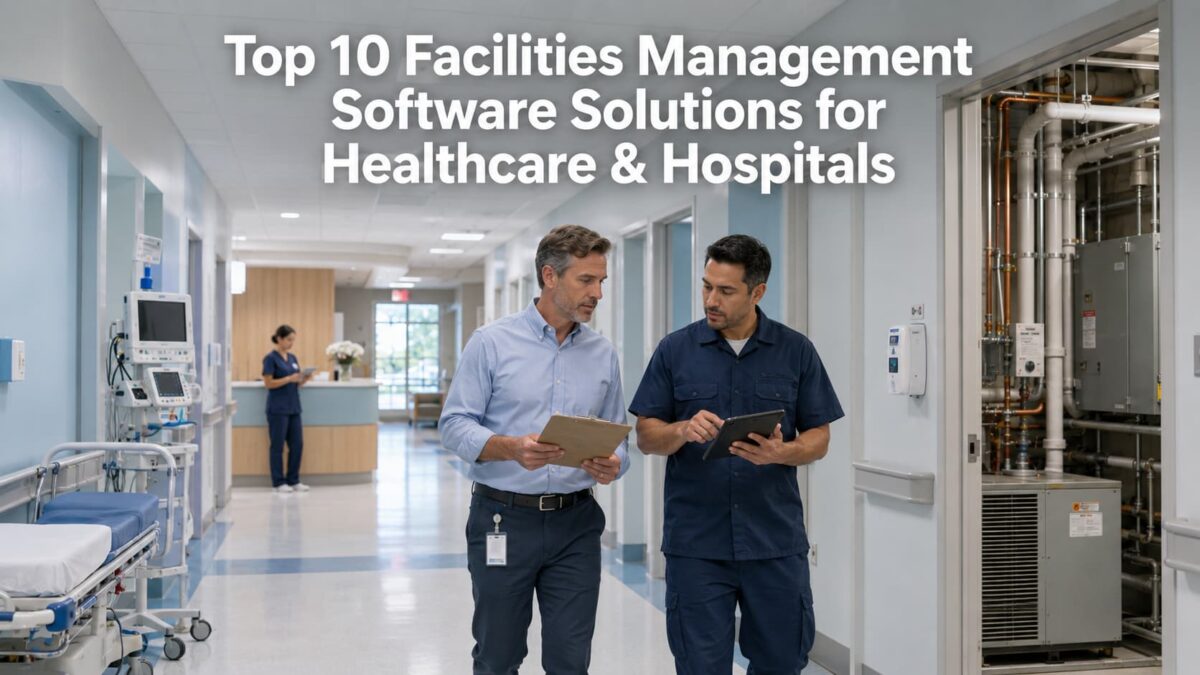
Healthcare facilities operate continuously, and even a minor maintenance failure can affect clinical schedules, patient safety, infection-control procedures, staff productivity, and inspection readiness. Hospitals therefore need more than basic work-order software. They need a reliable system for documenting equipment histories, scheduling preventive maintenance, coordinating technicians, managing facilities and clinical assets, and producing defensible records when surveyors request them.
The best facilities management software for healthcare depends on what the organization needs to manage. A community hospital may prioritize straightforward work orders and preventive maintenance, while a large health system may require enterprise asset management, clinical engineering workflows, space planning, real estate oversight, and integration across dozens of locations.
This guide compares ten leading healthcare CMMS, EAM, HTM, and IWMS platforms. The rankings consider healthcare specialization, maintenance functionality, biomedical equipment support, compliance documentation, mobile access, scalability, integrations, implementation demands, and overall suitability for U.S. healthcare organizations.
Editorial Information
| Editorial Detail | Information |
|---|---|
| Published | August 22, 2026 |
| Last reviewed | August 22, 2026 |
| Next scheduled review | August 2027 |
| Products evaluated | 10 |
| Target market | United States |
| Author role | Healthcare technology and facilities software researcher |
| Review method | Independent desk research using official product documentation, vendor resources, healthcare case studies, and authoritative regulatory sources |
Editorial Disclosure
This comparison is based on independent desk research. Rankings were not determined by vendor payments, sponsorships, or affiliate commissions. We did not conduct full hospital implementations or hands-on testing of every platform.
Product capabilities, ownership, integrations, pricing, and deployment arrangements can change. Hospitals should verify all requirements directly with shortlisted vendors before purchasing.
Quick Answer
FSI CMMS by Ultimo is our best overall healthcare facilities management software solution for 2026. It is purpose-built for healthcare facilities management and healthcare technology management teams, giving hospitals one platform for work orders, facility assets, biomedical equipment, preventive maintenance, compliance documentation, and mobile operations.
Accruent TMS is the strongest alternative for health systems with extensive clinical engineering and biomedical equipment requirements. Nuvolo Connected Workplace for Healthcare is particularly suitable for organizations seeking to connect facilities, HTM, IT, real estate, and capital planning.
TheWorxHub is a practical choice for hospitals and senior living organizations prioritizing approachable maintenance and compliance workflows. IBM Maximo is better suited to large health systems with complex enterprise assets, while Planon and FM:Systems are stronger when real estate, space utilization, and workplace planning are the primary concerns.
Key Takeaways
- FSI, Accruent TMS, Nuvolo, and TMA Systems provide the strongest combination of healthcare facilities and biomedical equipment functionality.
- IBM Maximo is highly scalable but generally requires more implementation expertise, configuration, and organizational resources.
- TheWorxHub and eMaint are strong maintenance platforms for teams that do not need the broad complexity of an enterprise EAM or IWMS.
- Planon and FM:Systems are most compelling for healthcare organizations focused on space, real estate, capital planning, and facility utilization.
- No software platform guarantees Joint Commission, CMS, NFPA, FDA, or HIPAA compliance. Software can support maintenance documentation, inspections, reporting, and audit readiness, but compliance remains the healthcare organization’s responsibility.
Best Healthcare Facilities Management Software at a Glance
| Rank | Product | Best For | Software Category | Pricing |
|---|---|---|---|---|
| 1 | FSI CMMS by Ultimo | Healthcare-specific facilities and HTM operations | Healthcare CMMS/EAM | Custom quote |
| 2 | Accruent TMS | Clinical assets and biomedical equipment | Healthcare CMMS/HTM | Custom quote |
| 3 | Nuvolo Connected Workplace | Connecting facilities, HTM, IT, and real estate | Healthcare CMMS/IWMS | Custom quote |
| 4 | Brightly TheWorxHub | Accessible maintenance and compliance workflows | Healthcare CMMS | Custom quote |
| 5 | TMA Systems WebTMA and EQ2 HEMS | Configurable facilities and medical equipment management | CMMS/EAM/HTM | Custom quote |
| 6 | IBM Maximo Application Suite | Large and operationally complex health systems | Enterprise EAM/IWMS | Custom quote |
| 7 | Facilio | Connected, multi-site hospital operations | CMMS/facilities platform | Custom quote |
| 8 | eMaint CMMS | Preventive maintenance and reliability | General CMMS | Custom quote |
| 9 | Planon IWMS | Healthcare real estate and space management | IWMS | Custom quote |
| 10 | FM:Systems Healthcare Solutions | Space utilization and facility planning | IWMS/space management | Custom quote |
Detailed Feature Comparison
| Product | Facilities Management | Clinical/Biomedical Assets | Space Management | Multi-Site Support | Mobile Access | Public Pricing |
|---|---|---|---|---|---|---|
| FSI CMMS by Ultimo | Strong | Strong | Available | Yes | Yes | No |
| Accruent TMS | Strong | Strong | Limited compared with IWMS | Yes | Yes | No |
| Nuvolo | Strong | Strong | Strong | Yes | Yes | No |
| TheWorxHub | Strong | Moderate | Limited | Yes | Yes | No |
| TMA Systems | Strong | Strong through EQ2 HEMS | Configurable | Yes | Yes | No |
| IBM Maximo | Strong | Configurable | Strong with Real Estate and Facilities | Yes | Yes | No |
| Facilio | Strong | Moderate | Moderate | Strong | Yes | No |
| eMaint | Strong | Configurable | Limited | Yes | Yes | No |
| Planon | Strong | Limited healthcare-specific HTM depth | Strong | Yes | Yes | No |
| FM:Systems | Moderate | Limited | Strong | Yes | Yes | No |
Understanding CMMS, EAM, IWMS, and HTM Software
Hospitals frequently encounter several overlapping software categories. Understanding their differences helps prevent an organization from buying a sophisticated product that does not address its primary problem.
Computerized Maintenance Management System
A CMMS focuses on day-to-day maintenance operations. Common features include work orders, preventive maintenance schedules, asset records, labor tracking, inspection checklists, inventory, service histories, and maintenance reporting.
Healthcare CMMS software is appropriate when the primary requirement is keeping buildings, utilities, equipment, and other physical assets maintained and documented.
Enterprise Asset Management
An EAM platform manages assets across their complete lifecycle, including acquisition, operation, maintenance, risk, costs, performance, replacement, and disposal.
EAM systems are usually more extensive than a standard CMMS. They are often selected by large organizations managing complex asset hierarchies, multiple facilities, and enterprise integrations.
Integrated Workplace Management System
An IWMS connects real estate, leases, space, capital projects, maintenance, energy, sustainability, and workplace services.
A healthcare IWMS is particularly relevant when a health system needs to understand how buildings and clinical spaces are allocated, occupied, maintained, and financially managed.
Healthcare Technology Management Software
HTM software focuses on medical devices and biomedical equipment. It may support preventive maintenance, calibrations, recalls, electrical safety testing, device histories, risk classifications, alternative equipment maintenance programs, cybersecurity information, and clinical engineering workflows.
Hospitals with extensive medical equipment inventories should not assume that every general CMMS offers sufficient HTM depth.
How We Selected and Ranked the Products
The ten platforms were evaluated using a consistent healthcare-focused framework. The main factors were:
- Healthcare specialization
- Facilities and work-order management
- Preventive and predictive maintenance
- Building and medical asset management
- Biomedical and clinical engineering support
- Inspection and audit documentation
- Mobile functionality
- Inventory and spare-parts management
- Space and real estate capabilities
- Multi-site scalability
- Reporting and analytics
- Integrations and APIs
- Implementation requirements
- Customer support and training
- Pricing transparency
- Overall usability and organizational fit
Particular attention was given to whether a platform can manage both physical facilities and medical equipment or whether it concentrates on only one operational area.
The Joint Commission requires hospitals to maintain essential mechanical, electrical, and patient-care equipment in safe operating condition. Its 2026 requirements also emphasize documented inspection, testing, and maintenance activities, including required frequencies, responsible personnel, equipment inventories, referenced standards, and results. Software can organize these records, but it does not replace a hospital’s maintenance program or regulatory responsibilities. The Joint Commission
1. FSI CMMS by Ultimo — Best Overall for Healthcare Facilities and HTM
FSI ranks first because healthcare is not simply an industry template added to a general maintenance product. The platform is purpose-built for healthcare facilities management and healthcare technology management.
FSI became part of Ultimo following an acquisition announced in 2025. Its current platform positioning continues to focus on healthcare maintenance, facilities, and clinical assets. FSI
Best For
Hospitals and health systems seeking one healthcare-specific platform for facilities, HTM, work orders, preventive maintenance, asset histories, and compliance documentation.
Key Healthcare Capabilities
FSI supports facility and biomedical asset records, maintenance scheduling, technician workflows, inspections, inventory, reporting, mobile access, and multi-site standardization.
Its healthcare focus is particularly valuable for organizations that want facilities and clinical engineering teams to work from a shared data environment without forcing a generic industrial CMMS to accommodate hospital processes.
FSI has also announced an integration with Fluke Biomedical OneQA, enabling medical device testing workflows to connect with FSI work orders. This is a meaningful differentiator for HTM departments that use compatible testing systems. FSI and Fluke Biomedical OneQA
Notable Strengths
- Purpose-built for healthcare facilities and HTM
- Supports both building and biomedical assets
- Cloud-based and scalable across health systems
- Mobile tools for technicians
- Configurable healthcare workflows
- Strong preventive maintenance and documentation capabilities
Important Limitations
- Pricing is not publicly disclosed.
- Implementation still requires asset-data preparation and workflow configuration.
- Hospitals using broad enterprise real estate or financial systems may require additional integrations.
- Organizations needing advanced lease administration and strategic workplace planning may prefer an IWMS.
Pricing
FSI uses custom pricing based on organizational requirements, implementation scope, users, facilities, and selected functionality.
Ideal Organization
FSI is best suited to community hospitals, regional healthcare networks, academic medical centers, and multi-site health systems that want healthcare-focused maintenance without adopting a general industrial EAM platform.
Editorial Verdict
FSI earns the top position because it offers the strongest balance of healthcare specialization, facilities management, HTM support, scalability, and practical maintenance functionality.
2. Accruent TMS — Best for Clinical Assets and Biomedical Equipment
Accruent TMS is a healthcare-specific CMMS designed for facilities and clinical engineering teams. It is particularly strong where biomedical asset records, work orders, preventive maintenance, equipment histories, and healthcare documentation are central to the purchasing decision. Accruent TMS
Best For
Health systems with large medical equipment inventories and established biomedical or clinical engineering departments.
Key Healthcare Capabilities
TMS centralizes facility and clinical assets across healthcare organizations. It supports work orders, preventive maintenance, asset performance, service histories, reporting, mobile workflows, and data used for equipment planning and replacement decisions.
The modern TMS cloud interface is browser-based and mobile-friendly, allowing technicians to manage work orders and asset information without relying exclusively on desktop access.
Notable Strengths
- Designed specifically for healthcare
- Strong biomedical and clinical engineering functionality
- Facilities and HTM support in one platform
- Mobile-friendly work-order management
- Flexible modules and configuration
- Suitable for multi-hospital health systems
Important Limitations
- Pricing is available only through a custom quote.
- Configuration can require significant planning in large health systems.
- It is not primarily a comprehensive real estate and workplace platform.
- Data migration from an older CMMS may be resource-intensive.
Pricing
Accruent does not publish standard TMS pricing. Costs depend on product scope, users, assets, facilities, implementation services, and integrations.
Ideal Organization
TMS is an excellent fit for hospital networks that place clinical asset management and biomedical maintenance at the center of their maintenance strategy.
Editorial Verdict
Accruent TMS ranks just behind FSI. Its clinical engineering depth is a major strength, but organizations seeking broader real estate and workplace management may need another Accruent product or an integrated platform.
3. Nuvolo Connected Workplace for Healthcare — Best for Connected Departments
Nuvolo takes a wider approach by connecting facilities, HTM, real estate, IT, environmental services, finance, and other operational departments.
Its healthcare platform manages biomedical and facility equipment while supporting space, real estate, vendors, capital planning, and cross-departmental workflows. Nuvolo Connected Workplace for Healthcare
Best For
Large hospitals and health systems seeking a common operational platform across facilities, clinical engineering, IT, real estate, and capital planning.
Key Healthcare Capabilities
Nuvolo includes HTM asset management, medical device workflows, facility maintenance, vendor coordination, real estate, space planning, and capital planning.
Its primary advantage is connected data. A hospital can reduce departmental silos and route issues to the appropriate support team while maintaining a more unified view of buildings, equipment, locations, vendors, and costs.
Notable Strengths
- Healthcare-specific Connected Workplace offering
- Strong HTM and biomedical equipment support
- Facilities, IT, real estate, and space capabilities
- Cross-department workflow coordination
- Enterprise scalability
- Broad planning and operational scope
Important Limitations
- The product’s breadth may exceed the needs of smaller hospitals.
- Implementation can require extensive process mapping and governance.
- Pricing is not publicly disclosed.
- Organizations may need specialist implementation support.
Pricing
Nuvolo provides customized pricing based on modules, organizational scale, deployment, integrations, and implementation requirements.
Ideal Organization
Nuvolo is best for multi-hospital systems seeking to replace departmental software silos with a broader connected workplace platform.
Editorial Verdict
Nuvolo ranks third because it combines healthcare CMMS and HTM functionality with real estate, space, and enterprise workplace processes. That breadth is powerful but also increases implementation complexity.
4. Brightly TheWorxHub — Best for Accessible Maintenance Workflows
TheWorxHub is a cloud-based healthcare operations and maintenance platform for hospitals and senior living communities.
It covers work orders, assets, preventive maintenance, inventory, inspections, compliance-related records, security rounds, and mobile access. Brightly TheWorxHub
Best For
Hospitals, senior living organizations, and healthcare operations teams that prioritize approachable work-order and maintenance workflows.
Key Healthcare Capabilities
TheWorxHub helps maintenance teams create and assign work orders, automate recurring tasks, track assets, monitor costs, maintain inventory, perform rounds, and report on compliance-related activities.
Mobile functionality allows technicians to access and update work orders while moving throughout a hospital or care facility.
Notable Strengths
- Designed for healthcare and senior living
- Accessible maintenance workflows
- Preventive maintenance scheduling
- Mobile access
- Inventory and asset tracking
- Compliance and inspection reporting
Important Limitations
- Biomedical and clinical engineering depth may be less extensive than FSI, Accruent TMS, Nuvolo, or EQ2 HEMS.
- Advanced real estate and space planning are not its primary strengths.
- Pricing is not publicly listed.
- Highly complex organizations may need additional integrations or platforms.
Pricing
TheWorxHub is sold through custom quotes.
Ideal Organization
TheWorxHub is suitable for hospitals, healthcare campuses, and senior care organizations that need a practical healthcare CMMS without the complexity of a broad enterprise EAM or IWMS.
Editorial Verdict
TheWorxHub ranks fourth because it balances healthcare-specific maintenance functionality with an approachable operational structure.
5. TMA Systems WebTMA and EQ2 HEMS — Best Configurable Healthcare Platform
TMA Systems now offers two particularly relevant platforms for healthcare: WebTMA for enterprise facilities and asset management and EQ2 HEMS for hospital equipment and biomedical teams.
TMA Systems acquired EQ2 in March 2025, bringing the healthcare-focused HEMS platform into its portfolio. HEMS is available as SaaS or on-premises software. TMA Systems acquisition of EQ2
Best For
Health systems that need configurable facilities management alongside specialist biomedical equipment maintenance.
Key Healthcare Capabilities
WebTMA supports facilities, work orders, inspections, preventive maintenance, asset management, inventory, reporting, and multi-site operations.
EQ2 HEMS is more focused on medical equipment. It supports preventive maintenance, calibrations, electrical safety tests, device histories, recalls, and clinical engineering records.
Hospitals can evaluate either platform independently or consider how the two products could support facilities and biomed departments with different operational requirements.
Notable Strengths
- WebTMA for enterprise facilities and maintenance
- EQ2 HEMS for biomedical and clinical engineering
- Configurable workflows and permissions
- SaaS and on-premises availability for HEMS
- Mobile access
- Suitable for complex health systems
Important Limitations
- Selecting and coordinating multiple products may complicate procurement.
- Configuration flexibility requires disciplined implementation.
- Pricing is not public.
- Users may require training to make full use of advanced functionality.
Pricing
TMA Systems provides customized pricing for WebTMA, EQ2 HEMS, implementation, integrations, and related services.
Ideal Organization
TMA Systems is best for hospitals that require substantial flexibility and want specialized tools for both facility operations and medical equipment.
Editorial Verdict
TMA Systems ranks fifth. Its combination of WebTMA and EQ2 HEMS is compelling, but buyers must carefully determine whether they need one platform, both products, or integrations with existing hospital systems.
6. IBM Maximo Application Suite — Best for Complex Health Systems
IBM Maximo Application Suite is a comprehensive enterprise asset management platform for organizations managing complex, high-value, and mission-critical assets.
Maximo brings maintenance, inspections, reliability, mobile operations, and asset lifecycle management into a unified environment. IBM also offers Maximo Real Estate and Facilities, the evolution of IBM TRIRIGA, for real estate, space, capital projects, energy, and facilities operations. IBM Maximo Application Suite
Best For
Large academic medical centers, statewide health systems, government healthcare organizations, and complex enterprises with extensive asset hierarchies and integration requirements.
Key Healthcare Capabilities
Maximo can manage facility assets, work orders, inspections, preventive and condition-based maintenance, inventory, labor, analytics, and mobile operations.
Its Real Estate and Facilities capabilities add portfolio planning, space management, capital projects, energy management, and workplace services. IBM lists healthcare among the industries supported by this product. IBM Maximo Real Estate and Facilities
Notable Strengths
- Enterprise-grade asset lifecycle management
- Advanced maintenance and reliability capabilities
- Facilities, real estate, and space functionality
- Strong integration potential
- Suitable for large multi-site enterprises
- Broad reporting, analytics, and mobile tools
Important Limitations
- Not purpose-built exclusively for U.S. hospital operations
- Greater implementation and administration complexity
- May require specialist partners or internal technical resources
- Customization can increase time and total ownership costs
- Pricing is not straightforward or publicly standardized
Pricing
IBM uses configuration- and deployment-dependent pricing. Hospitals should request detailed proposals covering software, implementation, hosting, integrations, support, and ongoing administration.
Ideal Organization
Maximo is most appropriate for large health systems that need enterprise EAM and have the technical, financial, and governance resources to support a major implementation.
Editorial Verdict
Maximo ranks sixth because it offers exceptional enterprise depth, but smaller hospitals may find it more complex than necessary.
7. Facilio — Best for Connected Multi-Site Hospital Operations
Facilio is a connected facilities platform designed to unify work orders, assets, vendors, compliance activities, and building operations across multiple sites.
Its healthcare offering is positioned for hospitals, FM teams, biomedical departments, and multi-site healthcare networks. Facilio Healthcare
Best For
Hospital networks and outpatient portfolios that want centralized operational visibility across numerous facilities.
Key Healthcare Capabilities
Facilio supports work orders, preventive maintenance, inspections, vendor management, asset tracking, mobile operations, reporting, and configurable workflows.
The platform can connect with building systems and other operational technology, making it relevant for organizations seeking a connected command center rather than an isolated maintenance database.
Notable Strengths
- Strong multi-site facilities management
- Mobile-first field workflows
- Vendor and service-level management
- Configurable automation
- Building-system and IoT connectivity
- Centralized portfolio visibility
Important Limitations
- Its healthcare specialization is newer than that of long-established healthcare CMMS platforms.
- HTM teams should verify the depth of medical-device workflows.
- Advanced hospital use cases may require configuration.
- Public pricing is unavailable.
- Vendor claims about AI and implementation speed should be validated against the buyer’s actual scope.
Pricing
Facilio provides custom pricing based on facilities, users, workflows, integrations, and implementation scope.
Ideal Organization
Facilio is best for multi-site hospitals, ambulatory networks, and healthcare facility service providers seeking a modern, connected operational platform.
Editorial Verdict
Facilio ranks seventh. It is a strong facilities and multi-site platform, but buyers with highly specialized clinical engineering requirements should compare it directly with FSI, TMS, Nuvolo, and EQ2 HEMS.
8. eMaint CMMS — Best for Preventive Maintenance and Reliability
eMaint is a general CMMS from Fluke Reliability with a dedicated healthcare offering. It manages work orders, assets, preventive maintenance, inventory, safety issues, reporting, and maintenance schedules. eMaint for Healthcare
Best For
Hospitals and clinics that want a flexible preventive maintenance and reliability platform without adopting a healthcare-specific enterprise suite.
Key Healthcare Capabilities
Healthcare teams can use eMaint to schedule calendar- or meter-based preventive maintenance, assign technicians and contractors, manage equipment histories, track parts, prioritize safety issues, and produce maintenance reports.
A published customer story describes a healthcare support services organization using eMaint to maintain approximately 13,000 assets, illustrating its ability to support a substantial maintenance portfolio. This is a vendor case study and should not be treated as a guaranteed result for other organizations. eMaint customer story
Notable Strengths
- Strong preventive maintenance capabilities
- Work orders, assets, inventory, and reporting
- Configurable dashboards and workflows
- Mobile functionality
- Suitable for numerous maintenance environments
- Established reliability-management ecosystem
Important Limitations
- Less healthcare-specific than the highest-ranked platforms
- Biomedical workflows may require configuration
- Limited strategic space and real estate functionality
- Pricing is not public
- Organizations must configure healthcare-specific terminology and processes
Pricing
eMaint provides custom pricing based on organizational needs, users, configuration, and services.
Ideal Organization
eMaint is suitable for hospitals, clinics, and support-service providers that prioritize preventive maintenance, reliability, and asset availability.
Editorial Verdict
eMaint ranks eighth because it is a capable and flexible CMMS, but it does not match the native healthcare and HTM depth of the leading products.
9. Planon IWMS — Best for Healthcare Real Estate and Space Management
Planon is an integrated workplace management system covering real estate, space, workplace services, asset maintenance, energy, sustainability, and smart-building integration.
Its IWMS combines four major domains: real estate management, space and workplace services, asset and maintenance management, and energy and sustainability management. Planon IWMS
Best For
Health systems managing large real estate portfolios, administrative space, clinics, leases, capital projects, workplace services, and facility utilization.
Key Healthcare Capabilities
Planon can support planned maintenance, facility assets, real estate, leases, space allocation, workplace services, sustainability, projects, reporting, and IoT-connected buildings.
Its strengths are broader facilities and portfolio management rather than specialist biomedical maintenance.
Notable Strengths
- Comprehensive real estate and facility management
- Strong space and workplace capabilities
- Asset and maintenance management
- Smart-building and IoT connectivity
- Energy and sustainability functionality
- Scalable portfolio reporting
Important Limitations
- Not primarily an HTM or biomedical equipment system
- Healthcare-specific workflows may require configuration
- Broad IWMS implementation can be complex
- Pricing is not public
- Hospitals may still need a separate clinical engineering CMMS
Pricing
Planon provides custom quotes based on selected domains, facilities, integrations, users, and implementation scope.
Ideal Organization
Planon is best for large health systems where real estate, space, workplace services, and facility portfolio management are more important than specialist biomed workflows.
Editorial Verdict
Planon ranks ninth because it solves a different problem from a healthcare CMMS. It is a strong IWMS but should not automatically replace dedicated HTM software.
10. FM:Systems Healthcare Solutions — Best for Hospital Space Utilization
FM:Systems provides facility, real estate, workplace, occupancy, and space-management solutions for healthcare organizations.
Its healthcare platform emphasizes hospital and medical facility efficiency through space information, occupancy data, facility analytics, and portfolio visibility. FM:Systems Healthcare
Best For
Health systems that need accurate information about space allocation, utilization, occupancy, real estate, and facility planning.
Key Healthcare Capabilities
FM:Systems supports space inventory, floor plans, utilization analytics, facility data, real estate information, workplace planning, and related reporting.
Healthcare organizations including Sutter Health and Highmark Health appear in vendor-published customer stories focused on facility utilization and portfolio visibility. These examples demonstrate potential use cases but do not guarantee identical outcomes. FM:Systems customer stories
Notable Strengths
- Strong hospital space management
- Utilization and occupancy analytics
- Real estate and facility portfolio visibility
- Floor-plan and workplace planning capabilities
- Suitable for large, distributed organizations
- Healthcare customer experience
Important Limitations
- Limited specialist biomedical maintenance functionality
- Not the strongest option for comprehensive work-order or HTM requirements
- May need to integrate with a dedicated CMMS
- Pricing is not publicly disclosed
- Sensor and data strategies require careful implementation
Pricing
FM:Systems provides custom pricing based on products, portfolio size, users, sensors, integrations, and implementation requirements.
Ideal Organization
FM:Systems is ideal for hospitals and health systems that need to understand exactly how clinical, administrative, and support spaces are allocated and used.
Editorial Verdict
FM:Systems ranks tenth because it is a specialist space and workplace solution rather than a complete hospital maintenance or biomedical platform. Within its intended use case, however, it is a strong option.
Head-to-Head Comparisons
FSI vs. Accruent TMS
FSI and Accruent TMS are the two strongest choices for organizations seeking a healthcare-specific CMMS covering facilities and HTM.
Choose FSI when you want a balanced platform for both healthcare facilities and clinical engineering. Choose Accruent TMS when biomedical equipment, clinical asset histories, and HTM operations carry greater weight.
Both require custom quotes and careful data migration.
Nuvolo vs. IBM Maximo
Nuvolo is better suited to hospitals that want a healthcare-oriented connected workplace platform spanning HTM, facilities, IT, space, and real estate.
IBM Maximo is stronger for enterprise asset lifecycle management, complex asset hierarchies, reliability, predictive maintenance, and extensive organizational configuration.
Nuvolo provides a more healthcare-focused starting point. Maximo offers greater enterprise breadth but can demand more implementation resources.
TheWorxHub vs. eMaint
TheWorxHub is preferable for healthcare and senior living organizations that want purpose-built, approachable maintenance workflows.
eMaint is stronger for general preventive maintenance and reliability programs that may extend beyond traditional healthcare operations.
Choose TheWorxHub for healthcare-specific usability. Choose eMaint for flexible maintenance and reliability management across diverse asset environments.
Facilio vs. TMA Systems
Facilio is strongest for connected, multi-site facilities operations, vendor coordination, mobile workflows, and building-system integration.
TMA Systems offers deeper healthcare history and stronger specialist options through WebTMA and EQ2 HEMS.
Choose Facilio for modern multi-site facilities connectivity. Choose TMA Systems when clinical engineering and configurable healthcare maintenance processes are more important.
Planon vs. FM:Systems
Planon offers a broad IWMS covering real estate, space, maintenance, workplace services, energy, sustainability, and smart buildings.
FM:Systems places greater emphasis on space utilization, occupancy analytics, floor plans, and facility planning.
Choose Planon for comprehensive IWMS requirements. Choose FM:Systems when the primary objective is gaining better control over hospital space and utilization data.
Healthcare Software Implementation Considerations
Choosing a platform is only the beginning. A poorly planned implementation can reproduce inaccurate spreadsheets, inconsistent equipment names, and incomplete maintenance histories inside an expensive new system.
Data Migration
Review asset records before importing them. Remove duplicates, standardize naming, confirm serial numbers, identify missing locations, and decide which historical work orders are worth retaining.
Asset Hierarchy
Create a consistent hierarchy covering health systems, campuses, buildings, floors, departments, rooms, utility systems, facility assets, and medical equipment.
The hierarchy should support both daily technician work and executive reporting.
Barcode and RFID Labeling
Hospitals should determine whether existing labels can be reused or whether assets require new barcodes, QR codes, or RFID tags.
The selected method must work with mobile devices, asset classes, infection-control procedures, and hospital labeling standards.
Integrations
Potential integrations include:
- Enterprise resource planning systems
- Procurement and inventory platforms
- Building automation systems
- Medical-device testing platforms
- Human resources systems
- Identity and access management
- Financial and capital planning software
- IoT sensors
- Real estate and space systems
- Service vendors and contractor portals
Each integration should have a defined owner, data direction, update frequency, failure process, and security review.
User Roles and Permissions
Facilities technicians, biomedical engineers, managers, contractors, compliance staff, IT administrators, and executives do not need identical access.
Role-based permissions should reflect job responsibilities and limit exposure of sensitive information.
Training and Mobile Adoption
Technicians should receive task-specific training based on real hospital workflows. Mobile screens should be tested in mechanical rooms, clinical departments, remote buildings, and areas with unreliable connectivity.
Data Governance
Assign responsibility for asset creation, naming rules, location changes, decommissioning, vendor records, preventive maintenance templates, and report definitions.
Without continuing governance, even a successful implementation will gradually accumulate unreliable data.
Healthcare Facilities Software Evaluation Checklist
Use this checklist when reviewing vendors:
- Does the platform support both facilities and biomedical assets?
- Can it separate facilities and HTM workflows when needed?
- Does it support preventive maintenance by calendar, meter, condition, or risk?
- Can technicians work from mobile devices?
- Is offline mobile access available?
- Can the system document inspections, test results, frequencies, and responsible personnel?
- Does it support alternative equipment maintenance program records?
- Can it manage recalls, calibrations, warranties, and device histories?
- Does it include inventory and spare-parts management?
- Can it manage vendors and contractors?
- Does it provide multi-site reporting?
- Are space and real estate capabilities included or available separately?
- Which APIs and prebuilt integrations are available?
- What implementation and migration services are included?
- What security documentation will the vendor provide?
- How are permissions, audit logs, and data retention managed?
- What training and ongoing support are included?
- How are software updates delivered?
- What is the full cost of implementation and ownership?
- Can the vendor provide relevant references from comparable U.S. healthcare organizations?
Frequently Asked Questions
What is facilities management software for healthcare?
Facilities management software for healthcare helps hospitals, clinics, and health systems manage work orders, building assets, preventive maintenance, inspections, technician activity, inventory, vendors, and operational records.
Healthcare-specific platforms may also manage biomedical equipment, clinical engineering workflows, space, real estate, or capital projects.
What is the best healthcare CMMS software?
FSI CMMS by Ultimo is our best overall choice because it is purpose-built for healthcare facilities and HTM operations.
Accruent TMS is particularly strong for biomedical equipment, while Nuvolo is suitable for organizations connecting facilities, clinical engineering, IT, and real estate.
The best choice ultimately depends on the organization’s assets, departments, locations, integrations, and implementation resources.
Can CMMS software guarantee Joint Commission compliance?
No. A CMMS cannot guarantee compliance or prevent a citation.
Software can support compliance by scheduling maintenance, documenting inspections, storing test results, tracking completion, preserving equipment histories, and producing reports. The hospital remains responsible for its maintenance program, policies, staff actions, documentation, and regulatory compliance.
Does healthcare facilities software need to be HIPAA compliant?
That depends on the information stored and processed by the platform.
Facilities and asset systems should generally avoid unnecessary protected health information. If the platform will store, receive, or transmit protected health information, the healthcare organization should complete a security and privacy review, verify the vendor’s safeguards, and determine whether a business associate agreement is required.
Never rely on a general “HIPAA-ready” marketing statement without reviewing current documentation and contractual terms.
What is the difference between hospital facilities software and biomedical equipment software?
Hospital facilities software manages buildings, HVAC, electrical systems, plumbing, generators, fire protection, utilities, rooms, and general facility assets.
Biomedical equipment maintenance software manages patient-care and diagnostic equipment, preventive maintenance, testing, calibrations, recalls, risk classifications, service histories, and clinical engineering workflows.
Some platforms cover both areas, while others specialize in one.
How much does healthcare facilities management software cost?
Most vendors in this comparison do not publish standardized prices.
Costs can depend on users, facilities, assets, modules, deployment, integrations, data migration, implementation services, training, support, and contract length.
Hospitals should compare total ownership costs rather than subscription fees alone.
How long does implementation take?
Implementation can range from several weeks for a focused CMMS deployment to many months for a large EAM or IWMS program.
The timeline depends on data quality, integrations, configuration, asset labeling, testing, training, internal approvals, and the number of facilities involved. Vendor estimates should be evaluated against the organization’s actual requirements.
Conclusion
The right facilities management software for healthcare is the platform that matches the organization’s operational scope—not necessarily the product with the longest feature list.
FSI CMMS by Ultimo is the strongest overall choice for hospitals seeking healthcare-specific facilities and HTM functionality. Accruent TMS is especially compelling for clinical engineering and biomedical equipment management, while Nuvolo is the better fit for health systems connecting facilities, HTM, IT, space, and real estate.
TheWorxHub works well for healthcare teams prioritizing accessible maintenance workflows. TMA Systems is a flexible choice for organizations combining facilities and specialist medical-equipment management. IBM Maximo is better suited to large, complex health systems with enterprise asset management resources.
Facilio is promising for connected multi-site operations, while eMaint provides strong preventive maintenance and reliability tools. Planon and FM:Systems should be considered when real estate, workplace planning, and hospital space utilization are the primary objectives.
Healthcare organizations should shortlist platforms according to their asset mix, regulatory documentation needs, integrations, implementation capacity, and long-term data strategy. Explore more expert recommendations on Listicles.
Disclaimer: Product features, pricing, integrations, ownership, and regulatory requirements may change. Verify current information with vendors and qualified compliance professionals before making purchasing or implementation decisions.
