
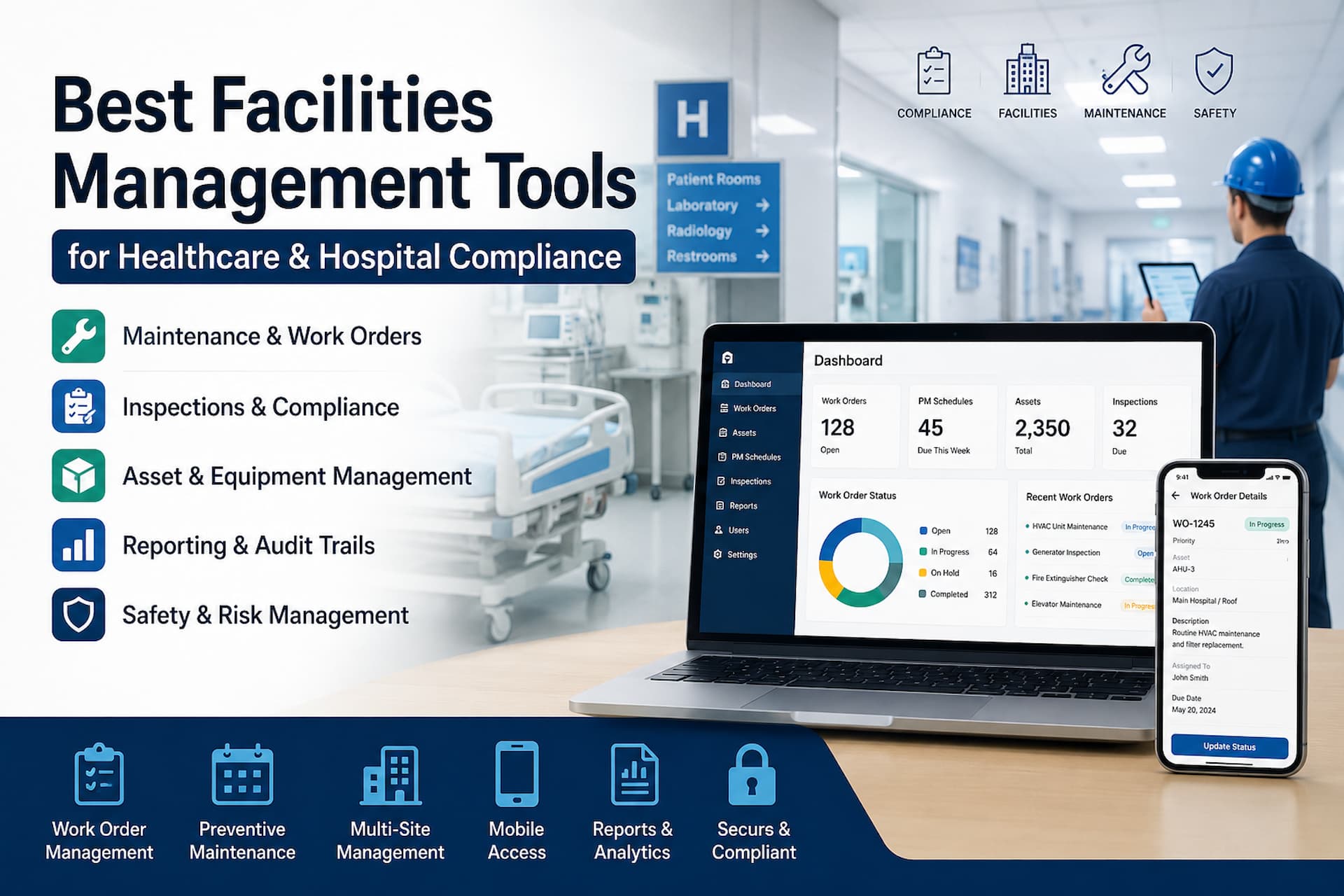
Healthcare facilities management software can help hospitals organize preventive maintenance, work orders, assets, inspections, safety documentation, and audit records. Among the stronger options worth investigating are Accruent TMS, Nuvolo Connected Workplace for Healthcare, Brightly TheWorxHub, eMaint, UpKeep, and FMX.
These platforms were selected through editorial research into healthcare specialization, maintenance capabilities, compliance-supporting workflows, reporting, mobile functionality, integrations, security information, and documented healthcare use. The right choice depends on facility size, clinical-engineering needs, regulatory responsibilities, existing technology, implementation resources, and budget. Importantly, no software platform independently guarantees regulatory compliance. CMS physical-environment requirements and Joint Commission Environment of Care expectations remain organizational responsibilities.
6 Best Healthcare Facilities Management Tools at a Glance
| Platform | Best For | Key Strength | Healthcare/Compliance Focus |
|---|---|---|---|
| Accruent TMS | Hospital systems and clinical engineering teams | Healthcare-specific CMMS and asset management | Purpose-built for healthcare |
| Nuvolo Connected Workplace | Large, complex healthcare networks | Connecting facilities, clinical assets, real estate and capital planning | Healthcare-specific enterprise platform |
| Brightly TheWorxHub | Hospitals prioritizing survey readiness | Life safety, EOC workflows and compliance documentation | Purpose-built for healthcare |
| eMaint | Configurable, multi-site maintenance operations | Flexible PM, asset and inspection management | General CMMS with healthcare solution |
| UpKeep | Mobile-first hospital facilities teams | Work orders, rounds and maintenance records | Healthcare facilities focused |
| FMX | Community hospitals and straightforward facilities operations | Accessible work orders and preventive maintenance | General CMMS with healthcare solution |
How We Selected These Healthcare Facilities Management Tools
This shortlist is based primarily on publicly available editorial research rather than hands-on product testing. We prioritized platforms with verifiable healthcare product pages, hospital case studies, healthcare maintenance functionality, preventive maintenance, work orders, asset histories, inspections, compliance documentation, reporting, mobile capabilities, multi-site support, integrations, and publicly documented security information.
Greater weight was given to platforms demonstrating actual hospital or healthcare use rather than general-purpose software that could theoretically be used in healthcare. The order is an editorial shortlist, not a scientific ranking or numerical score. Organizations should independently validate configuration, integrations, security controls, pricing, contractual terms, and compliance requirements before purchasing.
1. Accruent TMS — Best for Hospital Facilities and Clinical Engineering
Accruent TMS is a purpose-built healthcare CMMS designed to bring healthcare technology management, healthcare facilities management, and related operational data into one environment. The Accruent documents preventive maintenance, work-order management, asset tracking, mobile-friendly workflows, reporting, and healthcare-specific compliance fields and tools.
TMS stands out for organizations that want facilities and biomedical or clinical-engineering functions working from a healthcare-oriented system rather than adapting a generic maintenance platform. Accruent also publishes hospital case studies demonstrating real-world healthcare deployment.
Accruent lists SOC 2 and ISO/IEC 27001 among its security and compliance credentials, although organizations should confirm exactly which certifications and controls apply to their proposed TMS deployment. TMS pricing is tailored to healthcare organizations rather than presented as a simple fixed subscription.
2. Nuvolo Connected Workplace for Healthcare — Best for Large Healthcare Networks
Nuvolo Connected Workplace for Healthcare is particularly relevant to large hospital systems looking beyond basic work-order software. Its healthcare offering brings clinical equipment, facilities maintenance, real estate, space, capital planning, sustainability, and operational technology security into a broader connected-workplace platform.
For maintenance and compliance-related workflows, Nuvolo documents planned maintenance, equipment records, dashboards, reports, configured workflows, checklists, and Alternative Equipment Maintenance program support. Its healthcare platform is built natively on ServiceNow.
The platform may therefore be particularly suitable where facilities, HTM, IT, security, real estate, and finance require shared operational data. Nuvolo also publishes SOC 2 Type 2 and ISO 27001 information through its Trust Center.
Its breadth can be an advantage for complex enterprises, but hospitals should assess implementation scope, ServiceNow dependencies, integrations, modules, and total cost carefully.
3. Brightly TheWorxHub — Best for Life Safety and Compliance Documentation
TheWorxHub from Brightly Software is a healthcare-specific operations and CMMS platform with especially relevant capabilities for hospital facilities teams preparing for inspections and managing life-safety documentation.
Brightly documents hospital-specific functionality covering maintenance workflows, preventive maintenance, assets, mobile work orders, compliance activities, rounding, risk assessments, reporting, and inspections. Hospital customers such as Aspirus Wausau Hospital have used the platform for preventive maintenance, work orders, reporting, and compliance-related tracking.
A notable differentiator is Compliance Pro, which connects compliance-related activities with hospital work orders and provides digital compliance binders and permitting capabilities.
TheWorxHub also supports mobile access and documented SSO options. Hospitals should confirm which compliance, inspection, BioMed, and other capabilities require separate modules.
4. eMaint — Best for Configurable Multi-Site Healthcare Maintenance
eMaint, a Fluke company, is a configurable CMMS rather than an exclusively healthcare platform, but it has a dedicated healthcare solution for hospitals, clinics, outpatient centers, and other medical facilities. Its core capabilities include asset hierarchies, maintenance histories, work orders, preventive maintenance schedules, inspections, inventory, reporting, and mobile access.
The platform is particularly worth considering for healthcare organizations that want extensive configuration or need to standardize maintenance across multiple sites. eMaint also documents hospital-related deployments, including HHS support operations and the Health and Hospital Corporation of Marion County.
Current plans are configurable, with Professional and Enterprise offerings and multi-site, API, SSO, audit-trail, and offline-mobile capabilities varying by tier. eMaint publishes ISO 27001 information and has completed a SOC 2 Type II audit.
5. UpKeep — Best for Mobile-First Hospital Facilities Maintenance
UpKeep offers a healthcare CMMS focused on hospital, clinic, and senior-living facilities operations. Its healthcare workflows cover maintenance requests, preventive maintenance, asset history, scheduled Environment of Care-style rounds, checklists, photographs, timestamps, sign-offs, and corrective actions.
One particularly useful point is UpKeep’s own limitation statement: the company does not position the platform as a specialist biomedical-equipment management system. Its healthcare offering is primarily aimed at facilities assets such as HVAC, chillers, boilers, generators, plumbing, and life-safety infrastructure. That makes the distinction clearer for hospitals already running a dedicated clinical-engineering platform.
UpKeep is SOC 2 Type II examined, offers role-based access controls, and provides SSO at higher tiers. As of September 3, 2026, published Maintenance pricing starts at $24 per user/month, while more advanced Professional and Enterprise deployments require quotes.
6. FMX — Best for Straightforward Healthcare Facilities Operations
FMX is a broader facilities and maintenance platform with a dedicated healthcare offering. It supports staff-submitted work requests, preventive maintenance, equipment maintenance, inventory management, reporting, and asset-related workflows.
Its relatively straightforward facilities-management approach may make it worth considering for community hospitals, clinics, outpatient organizations, and healthcare operations that do not need the deeper clinical-asset specialization of platforms such as Accruent TMS or Nuvolo.
FMX also offers integrations and a REST API, while SAML 2.0 SSO can connect the platform with supported identity providers.
Standard healthcare pricing is not published as a fixed price. FMX states that pricing depends on the number of users and enabled features or workflows, with an implementation fee also applying.
How to Choose the Right Healthcare Facilities Management Tool
Healthcare-Specific Requirements
Start by determining whether you need a general facilities CMMS or a healthcare-specific system that also covers clinical equipment, Environment of Care processes, life-safety activities, or biomedical workflows.
Maintenance and Asset Management
Compare work-order routing, preventive maintenance schedules, recurring inspections, asset histories, equipment criticality, inventory, mobile capabilities, and multi-site reporting.
Compliance Documentation
Look for tools that make maintenance records, inspection results, deficiencies, corrective actions, permits, and audit histories easy to retrieve. The Joint Commission identifies physical-environment areas including fire safety, medical equipment, utility systems, hazardous materials, security, and environmental safety as important organizational management areas.
Security and Integration
Review authentication, permissions, audit controls, encryption, SSO, APIs, integrations, hosting arrangements, data retention, and security certifications. If a facilities platform will create, receive, maintain, or transmit ePHI on behalf of a covered entity, HIPAA requirements—including appropriate risk analysis and potentially a Business Associate Agreement—must be evaluated.
Cost and Implementation
Compare licensing with configuration, migration, integrations, training, professional services, additional modules, support, and long-term administration. A lower headline subscription price does not necessarily mean a lower total implementation cost.
Frequently Asked Questions
What is healthcare facilities management software?
Healthcare facilities management software helps organizations coordinate activities such as work orders, preventive maintenance, physical assets, inspections, facility requests, maintenance documentation, inventory, and reporting. Some platforms also provide healthcare-specific capabilities for life safety, Environment of Care workflows, clinical equipment, compliance documentation, or multi-hospital operations.
Can facilities management software help with hospital compliance?
Yes, it can support compliance-related processes by organizing inspection records, preventive maintenance histories, corrective actions, work orders, asset documentation, audit trails, and reports. However, software does not itself make an organization compliant. Hospitals remain responsible for applying applicable regulations, accreditation requirements, policies, risk assessments, documentation practices, and oversight correctly.
What is the difference between CMMS and facilities management software?
A CMMS primarily focuses on maintenance operations, including work orders, assets, preventive maintenance, parts, inspections, and maintenance histories. Broader facilities management or IWMS platforms can additionally cover areas such as space, real estate, capital projects, sustainability, workplace operations, and portfolio management.
Final Thoughts
There is no single best healthcare facilities management platform for every hospital. Accruent TMS and Nuvolo stand out for complex hospital and enterprise environments, while TheWorxHub offers particularly relevant healthcare compliance-documentation and life-safety workflows. eMaint provides extensive configurability, UpKeep is attractive for mobile-first facilities maintenance, and FMX may suit organizations seeking a comparatively straightforward facilities-management system.
Before selecting healthcare CMMS software, compare healthcare-specific capabilities, preventive maintenance, inspection documentation, asset scope, security, integrations, implementation demands, and total cost. Most importantly, treat software as an operational and documentation tool—not as a substitute for regulatory expertise, policies, oversight, or properly managed compliance programs.
Editorial Disclosure
No commercial relationship with any company listed above was disclosed in the editorial brief used to prepare this article. If the publisher has an advertising, affiliate, client, partnership, sponsorship, or other commercial relationship with a listed vendor, that relationship should be disclosed before publication. Such relationships should not automatically determine inclusion or ranking.
Healthcare organizations should independently evaluate every platform according to their operational, technical, security, procurement, and regulatory requirements.
Review Disclaimer
This article is for informational purposes and is based primarily on editorial research and publicly available product information reviewed in September 2026. The platforms were not purchased, deployed, or independently tested for this article.
Features, integrations, pricing, certifications, security controls, and product offerings can change. Inclusion does not guarantee suitability for a particular hospital, and none of these platforms independently guarantees CMS, Joint Commission, OSHA, NFPA, HIPAA, or other regulatory compliance. Healthcare organizations should verify critical information with vendors and involve relevant facilities, compliance, IT, cybersecurity, legal, clinical-engineering, and procurement professionals before implementation.
Last Checked: September 3, 2026 | Review Due: November 25, 2026
