

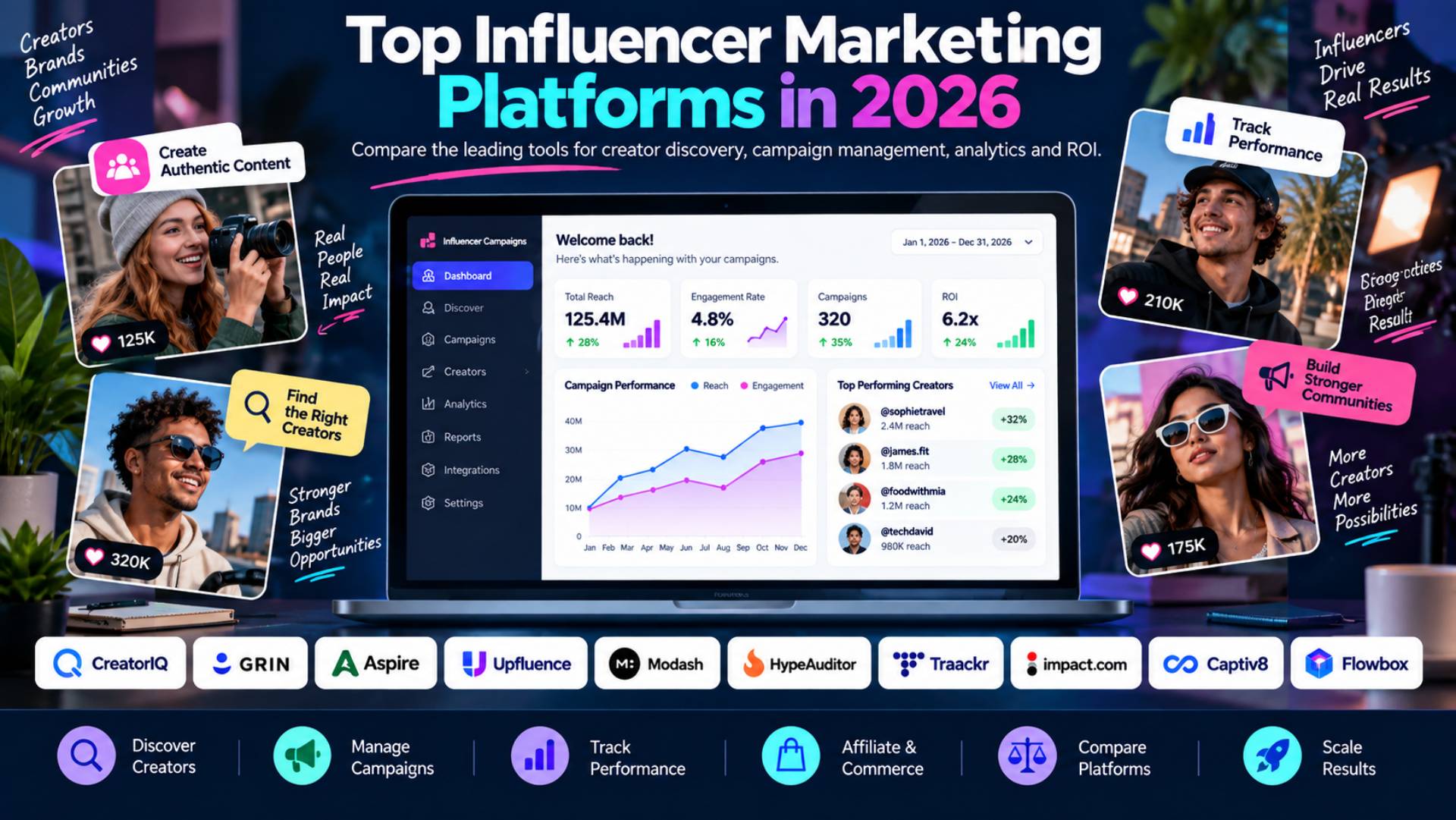
Choosing between influencer marketing platforms has become harder as the software category expands beyond simple creator discovery. Modern tools can help brands find creators, manage relationships, send products, approve content, track sales, process payments, analyse audiences, monitor brand safety, and manage affiliate campaigns.
The challenge is that these platforms are not interchangeable. Some are built for enterprise marketing teams managing creators across multiple countries. Others are better suited to ecommerce brands, agencies, lean in-house teams, UGC campaigns, or businesses that mainly need influencer analytics and vetting.
This guide to the best Influencer Marketing Platforms compares 10 leading tools based on creator discovery, campaign management, analytics, ecommerce capabilities, relationship management, payments, automation, pricing transparency, integrations, and scalability.
The market is also becoming more important to advertisers. IAB projected U.S. creator advertising spend at $44 billion for 2026, while 48% of creator ad buyers in its research described creators as a “must buy.” The same study found that three in four brands were already using or planning to use AI for creator-marketing tasks.
Table of Contents
Best Influencer Marketing Platforms at a Glance
| Platform | Best For | Standout Capability | Pricing | Main Consideration |
|---|---|---|---|---|
| CreatorIQ | Large global brands | Enterprise creator management and measurement | Pricing on request | Better aligned with mature programs |
| GRIN | Growing creator programs | AI-assisted campaign operations | Free; paid plans from $200/month | Usage is credit-based |
| Aspire | Ecommerce and community-led brands | Marketplace, workflows and Shopify integration | Pricing on request | Sales-led buying process |
| Upfluence | Ecommerce and performance campaigns | Creator sales attribution and ecommerce integrations | Custom pricing | Minimum contract is generally 12 months |
| Modash | Lean teams and creator discovery | Large discovery database and transparent pricing | From $299/month on current annual pricing | Best ecommerce functionality centres on Shopify |
| HypeAuditor | Analytics and creator vetting | Audience quality, fraud detection and market intelligence | Pricing not publicly listed | Advanced analysis may exceed simpler campaign needs |
| Traackr | Global influencer programs | Data-driven planning and program measurement | Pricing on request | Primarily aimed at established teams |
| impact.com | Creator + affiliate programs | Performance-based partnership management | Performance plans from $30/month | Creator requirements vary by plan |
| Captiv8 | Enterprise and brand-safety-conscious teams | Brand/media safety and full-funnel measurement | Pricing on request | Less suited to buyers seeking simple self-service pricing |
| Flowbox | UGC and social commerce | Influencer marketing combined with UGC commerce | Pricing on request | Broader commerce suite may exceed narrow discovery needs |
The best influencer marketing platform depends on your campaign type, team size, and growth goals—not simply the longest feature list. CreatorIQ and Traackr are better suited to large enterprise programs, while GRIN, Aspire, and Upfluence fit ecommerce and ongoing creator campaigns. Modash is a strong option for streamlined creator discovery, HypeAuditor focuses on influencer analytics and audience quality, impact.com connects creator and affiliate marketing, Captiv8 supports enterprise measurement and brand safety, and Flowbox stands out for UGC and social commerce. Choose based on the capabilities your team will actually use.
What Is an Influencer Marketing Platform?
An influencer marketing platform is software that helps businesses organise some or all of the process of finding, evaluating, contacting, managing, tracking, and paying social media creators.
Depending on the software, an influencer platform may provide creator discovery, audience analysis, influencer CRM features, outreach, campaign workflows, content approval, automated post tracking, affiliate links, product gifting, UGC management, payments, ecommerce attribution, fraud detection, and reporting.
Not every platform covers the complete workflow. Some tools specialise in influencer discovery and analytics, while others are designed as end-to-end creator management systems. There are also platforms that combine influencer marketing with affiliate management, social commerce, or UGC.
That distinction matters when comparing software. A company running occasional awareness campaigns may need something very different from a global ecommerce brand managing hundreds of creators, payments, product shipments, contracts, and sales attribution every month.
How Influencer Marketing Platforms Work
A typical influencer campaign workflow looks like this:
- Search for suitable creators.
- Evaluate their audience, content and previous performance.
- Contact, invite or recruit selected creators.
- Agree on campaign requirements and compensation.
- Manage briefs, deliverables and content approvals.
- Track published creator content.
- Measure reach, engagement, clicks, conversions or sales.
- Pay creators and maintain relationships for future campaigns.
The strongest influencer campaign management tools reduce the number of spreadsheets, inboxes, manual searches and disconnected reporting systems involved in this process.
Why Brands Use Influencer Marketing Platforms
Creator marketing becomes operationally difficult long before a brand reaches hundreds of influencers. Finding suitable creators, keeping track of conversations, checking deliverables, gathering content, shipping products and measuring results can consume considerable team time.
The right Influencer Marketing Software helps centralise these activities, giving teams one place to manage creators, campaigns, content, communication, tracking, and reporting.
This is becoming especially important as creator budgets grow. According to IAB’s U.S. research, identifying the right creators remains one of advertisers’ biggest challenges. The study also found that creator campaigns are used for more than awareness: 32% of surveyed buyers cited online sales or conversions as a campaign objective.
Platforms can therefore provide value through better organisation as much as creator discovery. The relevant question is not simply, “How many influencers are in the database?” It is whether the software improves the parts of your creator workflow that currently create the most friction.
How We Selected the Best Influencer Marketing Platforms
When reviewing Influencer Marketing Tools 2026, this comparison evaluates platforms across several practical buying criteria, including creator discovery, campaign management, analytics, ecommerce integrations, pricing transparency, and suitability for different organisations.
This comparison evaluates platforms across several practical buying criteria:
- creator discovery and database coverage;
- audience and authenticity analysis;
- campaign management;
- creator relationship management;
- outreach and communication;
- UGC and content workflows;
- ecommerce and affiliate integrations;
- sales and conversion tracking;
- analytics and reporting;
- creator payments;
- automation;
- scalability;
- pricing transparency;
- suitability for different types of organisations.
The platforms were not tested hands-on for this article. They were researched using current official product pages, documentation, help centres, integration pages and pricing information available as of September 16, 2026.
Public claims from each company have been treated as vendor-supplied information rather than independent performance guarantees.
Best Influencer Marketing Platforms in 2026
1. CreatorIQ
CreatorIQ is primarily positioned for brands and agencies that need to operate creator marketing at enterprise scale. Its platform brings discovery, creator relationship management, campaigns, payments and measurement into one system, while allowing larger organisations to standardise processes across markets and teams. CreatorIQ specifically positions its enterprise product around centralised governance and consistent measurement across brands, regions and agencies.
Discovery is content- and data-driven, with AI-supported recommendations and brand-safety information. CreatorIQ also supports creator payments, structured workflows and configurable reporting. Its integration ecosystem includes major social networks alongside ecommerce, analytics, affiliate, payment and business applications.
Its main distinction is therefore not simply creator search. For enterprise teams comparing the best Tools for Influencer Marketing, CreatorIQ makes more sense when influencer marketing has become a substantial business operation involving multiple stakeholders, campaigns, markets, and reporting requirements.. CreatorIQ makes more sense when influencer marketing has become a substantial business operation involving multiple stakeholders, campaigns and reporting requirements.
Pricing is not publicly displayed; businesses need to request pricing from CreatorIQ.
CreatorIQ is perfect for:
- Enterprise brands operating influencer programs across multiple markets.
- Agencies managing complex creator programs for large clients.
- Teams requiring standardised governance, workflows and reporting.
- Organisations that need creator discovery, management, measurement and payments within one ecosystem.
CreatorIQ is not suited for:
- Small teams looking for inexpensive self-service influencer software.
- Businesses that want transparent monthly pricing before speaking with sales.
- Companies running only occasional, small creator campaigns.
2. GRIN
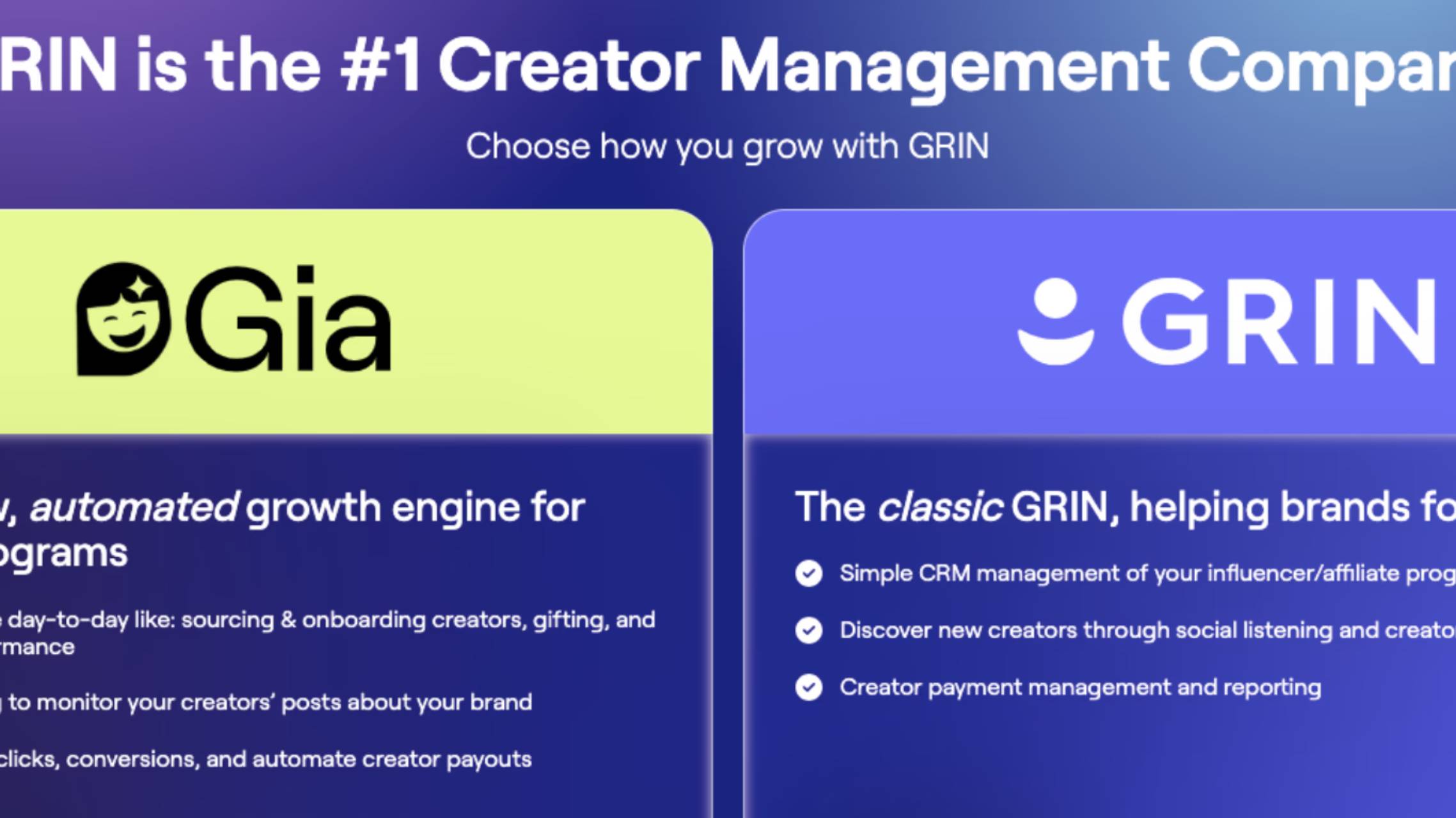
GRIN has changed significantly in 2026. Its current model combines its creator marketing platform with Gia, an AI agent that can perform work across creator discovery, outreach, gifting, reporting and other campaign operations while leaving consequential actions such as money, contracts and brand-risk decisions for human approval.
The broader GRIN platform supports relationship management, discovery and recruitment, product seeding, content management, reporting, ecommerce workflows and creator payments. Its ecommerce capabilities include Shopify connectivity, while other storefronts can use GRIN’s tracking SDK and webhooks.
Pricing is unusually transparent for this category. GRIN currently offers a free plan with 200 monthly Gia credits. Starter costs $200 per month, Growth $500, Scale $1,000 and Complete $1,500. Paid usage can continue through metered credits, subject to a cap controlled by the customer. Plans are month-to-month rather than requiring an annual contract.
That makes GRIN more accessible than its older enterprise-only reputation might suggest.
GRIN is perfect for:
- Brands that want to start small and scale a creator program gradually.
- Ecommerce businesses combining gifting, affiliates and creator campaigns.
- Teams interested in AI-assisted campaign operations.
- Buyers who prefer published pricing and month-to-month plans.
GRIN is not suited for:
- Teams that dislike usage-based or credit-based software pricing.
- Organisations wanting every creator operation handled manually rather than with AI assistance.
- Buyers that only need standalone influencer analytics without broader campaign tools.
3. Aspire
Aspire is particularly well aligned with ecommerce brands that want to build long-term communities of influencers, ambassadors, affiliates and content creators.
The platform combines traditional creator discovery with a marketplace where creators can apply to brand opportunities. Aspire says its discovery technology can reach more than 170 million influencers, while its broader platform includes campaign management, relationship workflows, agreements, content approval, creator payments, affiliate links, promotional codes and reporting.
Aspire also places considerable emphasis on ecommerce. Shopify integration can support product fulfilment, and brands can connect creator activity to sales, promo codes and affiliate links. Automated workflows can trigger actions based on campaign stages and conversion or revenue milestones.
This combination makes Aspire more than an influencer search database. It is strongest when a company wants to develop an ongoing creator community and automate much of the administration surrounding it.
Pricing is not publicly displayed on Aspire’s current website. Prospective customers are directed to book a demo.
Aspire is perfect for:
- Ecommerce brands developing ongoing influencer and ambassador communities.
- Shopify stores using product seeding and creator fulfilment.
- Teams combining influencer campaigns with affiliate incentives.
- Brands wanting marketplace recruitment alongside outbound discovery.
Aspire is not suited for:
- Buyers requiring transparent self-service pricing.
- Very small businesses that need only occasional influencer searches.
- Teams looking for a lightweight analytics-only product.
4. Upfluence
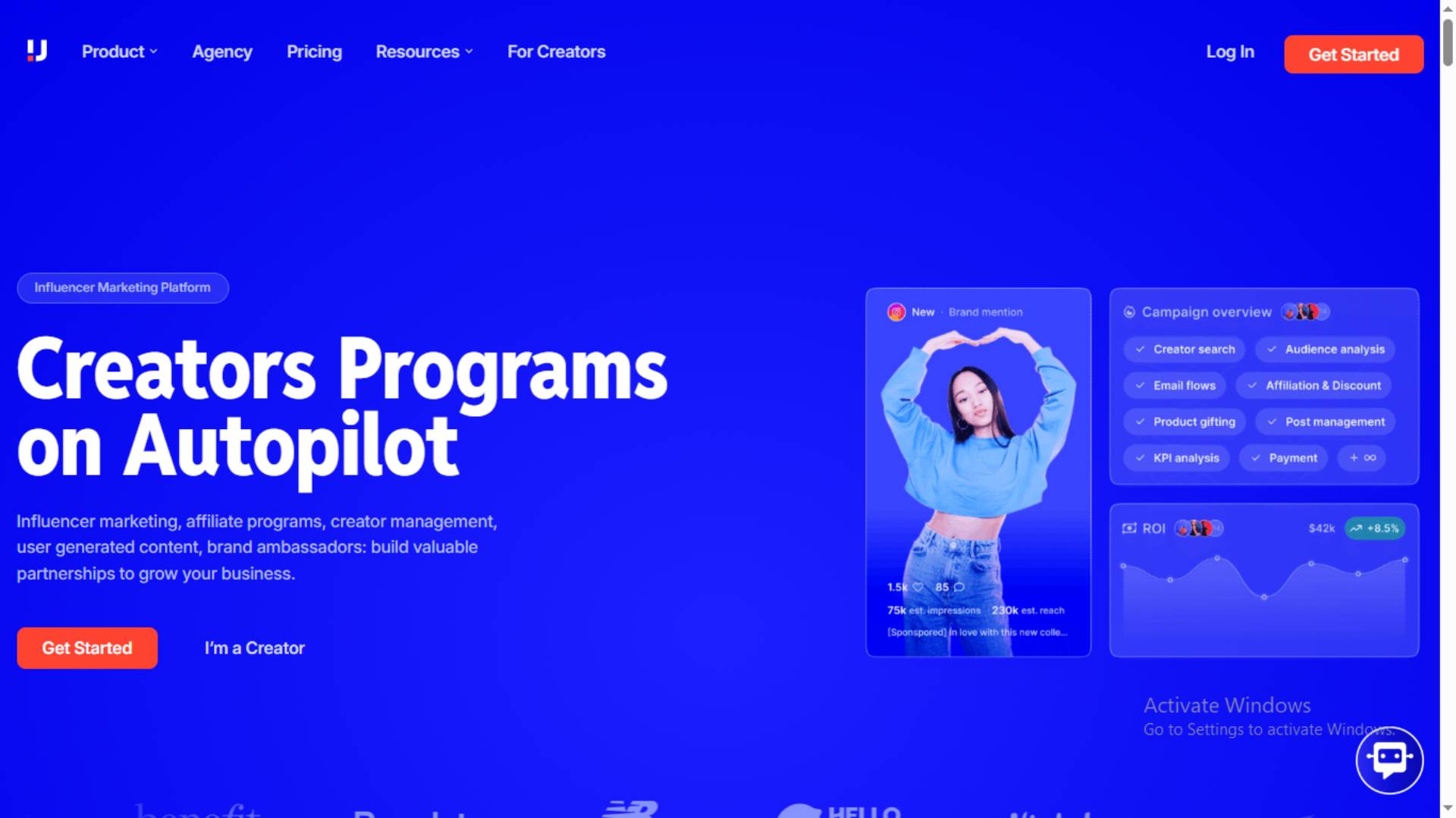
Upfluence is one of the stronger options for businesses that want creator marketing closely connected to ecommerce performance.
The platform combines a creator database, influencer outreach, campaign management, CRM software functionality, affiliate tracking, creator payments and sales analytics, creator payments and sales analytics. Upfluence lists integrations with Shopify, WooCommerce, Magento, BigCommerce and Amazon, making commerce connectivity an important part of its positioning.
Its current plans are organised around three levels of need: finding creators, scaling creator programs, and running programs with greater automation. More advanced configurations add ecommerce workflows, affiliate and discount management, product shipment, sales analytics and creator payments. Upfluence also offers its Jaice AI functionality for creator discovery, outreach and campaign creation.
Pricing is custom quoted rather than publicly fixed. Upfluence states that pricing depends on selected modules, team size and program volume. It also states that its minimum contract is 12 months, although a configured free trial can be arranged after an initial call.
Upfluence is perfect for:
- Ecommerce companies that want creator activity connected to sales.
- Brands running affiliate and influencer programs together.
- Teams sending products to creators at scale.
- Businesses requiring campaign analytics, payments and creator CRM functions.
Upfluence is not suited for:
- Buyers who want month-to-month software with published pricing.
- Companies unwilling to make a longer contractual commitment.
- Very small creator programs requiring only occasional discovery.
5. Modash
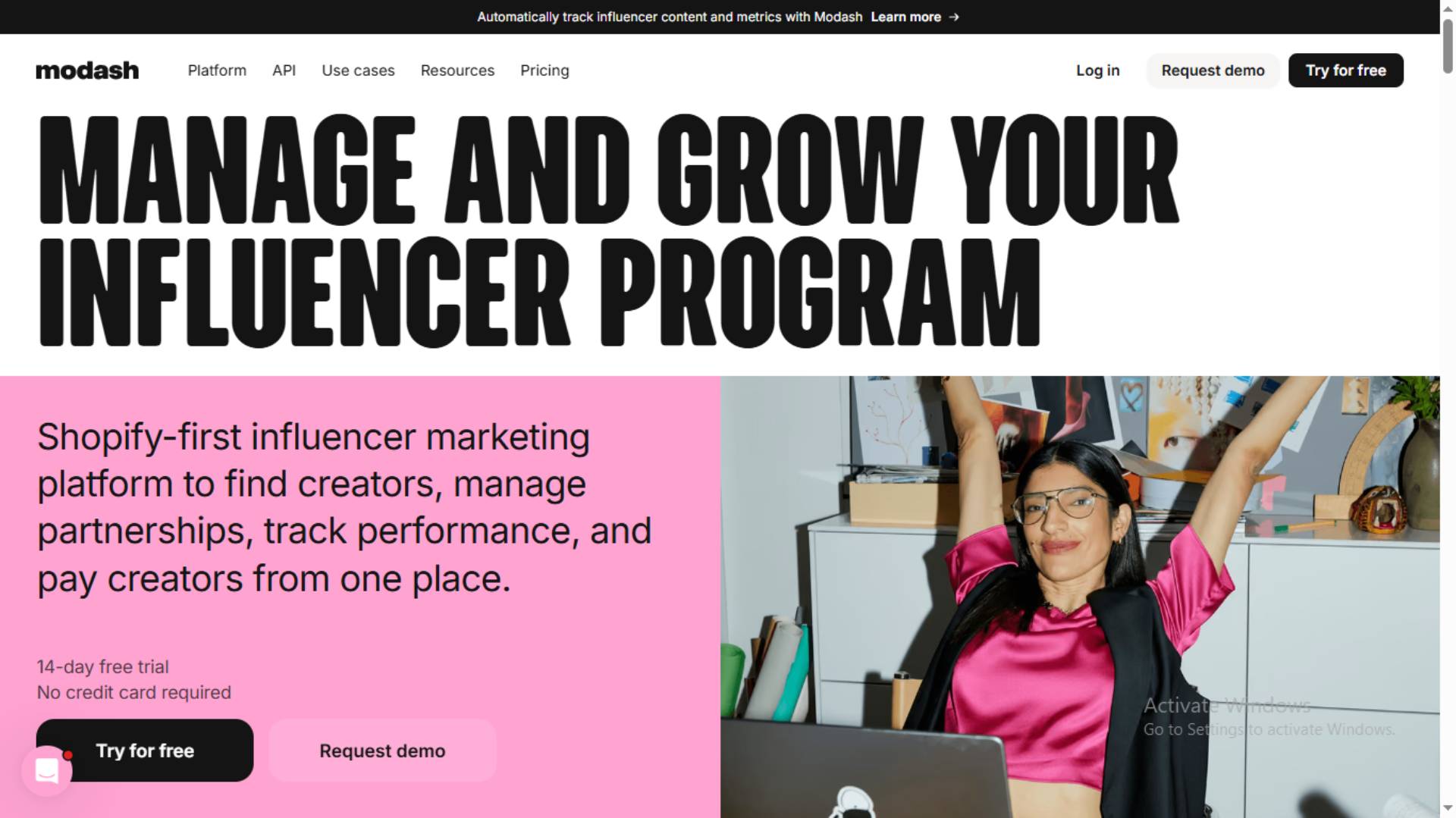
Modash is particularly attractive for lean marketing teams that want broad creator discovery without immediately moving into an enterprise sales process.
Its discovery database currently covers more than 350 million public creator profiles across Instagram, TikTok and YouTube, with filters for factors such as audience demographics, engagement and location. The platform combines that discovery layer with influencer CRM, email outreach, campaign tracking and payments.
One noteworthy difference is that creators do not need to join Modash simply to become discoverable. Brands can work directly with public creator profiles, while outreach can come from the brand’s own connected email account. Modash also supports automatic content tracking, audience analysis and campaign reporting.
Its Shopify integration adds gifting, automatic sales tracking, promotional codes and affiliate functionality. This is important because Modash itself notes that Shopify-connected brands receive the most complete ecommerce experience.
Current pricing lists Essentials at $299 per month on annual billing ($3,588 per year) and Performance at $599 per month on annual billing ($7,188 per year), alongside an Enterprise tier. A 14-day trial is available without a credit card.
Modash is perfect for:
- Lean teams prioritising influencer discovery and outreach.
- Brands that want transparent pricing before talking with sales.
- Shopify businesses that need gifting, affiliate tracking and sales attribution.
- Companies that want to discover creators without requiring those creators to join a marketplace first.
Modash is not suited for:
- Companies relying heavily on ecommerce platforms other than Shopify for advanced creator-commerce workflows.
- Brands needing highly customised global enterprise governance.
- Buyers whose only requirement is a basic free influencer-search tool.
6. HypeAuditor
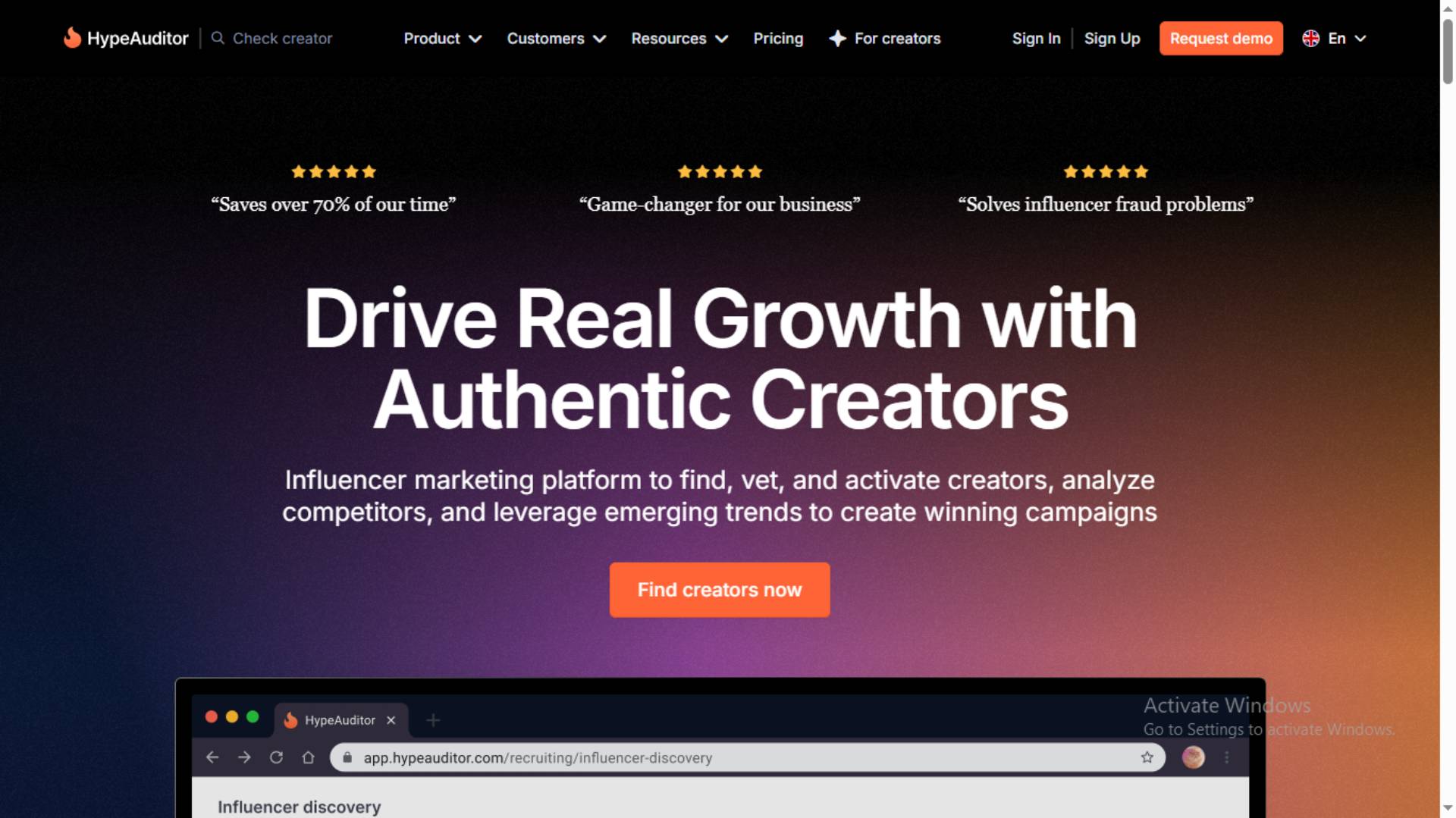
HypeAuditor stands out for influencer analytics, audience quality analysis and creator vetting.
Its platform covers discovery, creator analysis, campaign management, market research and competitive intelligence. HypeAuditor’s discovery tools span Instagram, YouTube, TikTok, Twitch and X, while its Instagram database alone covers more than 228 million accounts and provides over 35 filtering options.
The platform goes particularly deep on authenticity. Brands can analyse audience demographics, engagement, brand affinity and suspicious follower behaviour before deciding whether to approach a creator. HypeAuditor’s campaign system then extends into outreach, agreements, payments, automatic content tracking, promo codes and tracking links.
For agencies, its Media Plans functionality is also notable. Teams can create client-facing campaign proposals containing creators, projected reach, audience fit and performance estimates, then share updated plans through a link or PDF.
Detailed paid pricing is not publicly listed. HypeAuditor provides free tools and says full-product trials can be granted on request.
HypeAuditor is perfect for:
- Brands where creator authenticity and audience quality are major concerns.
- Agencies performing influencer research and campaign planning.
- Teams needing competitor, market and creator intelligence.
- Marketers that want deep influencer analytics before committing campaign budget.
HypeAuditor is not suited for:
- Buyers looking primarily for inexpensive basic campaign administration.
- Teams that do not require detailed creator or audience analysis.
- Companies requiring fully transparent paid plan pricing on the website.
7. Traackr
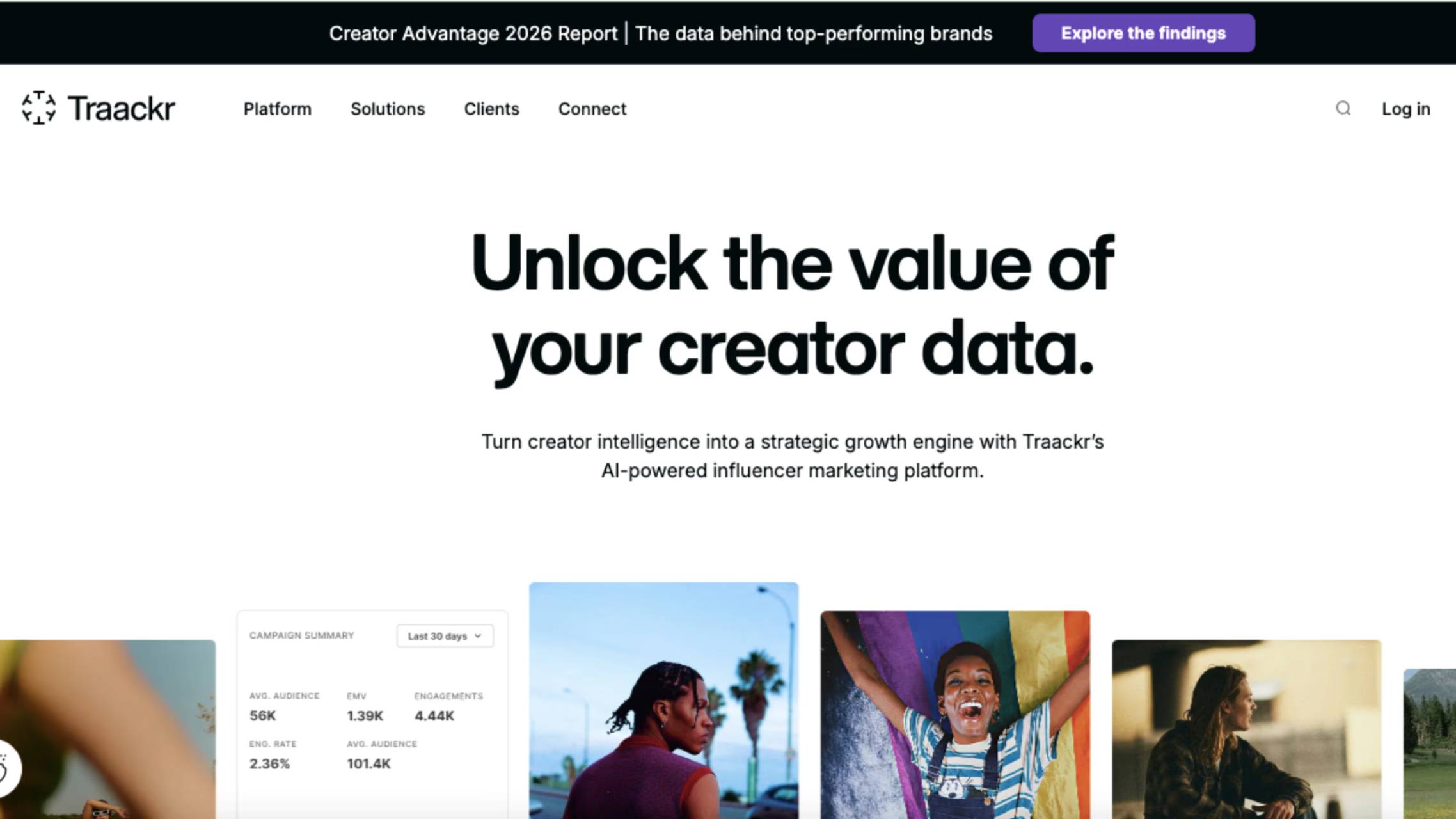
Traackr is designed for mature influencer programs that want planning, discovery, creator relationship management and performance measurement supported by extensive data.
Its discovery functionality uses content analysis, lookalike discovery and audience information to help teams identify relevant creators. Once creators are selected, Traackr can organise campaign briefs, relationship history, gifting and performance data within the same environment.
The software’s strongest use case is less about running a single sponsored campaign and more about creating a systematic influencer program. Traackr positions its technology around helping program owners compare creators, monitor content and measure both paid and organic creator activity across campaigns.
That makes it particularly relevant to global beauty, consumer and lifestyle brands where influencer marketing has become an established channel requiring consistent data and internal reporting.
Traackr does not publicly display standard plan prices. Prospective customers are directed to speak with a platform specialist about pricing and packages.
Traackr is perfect for:
- Established brands running structured influencer programs.
- Global teams needing consistent creator and campaign data.
- Businesses that place strong emphasis on measurement and benchmarking.
- Marketing teams managing ongoing creator relationships rather than one-off activations.
Traackr is not suited for:
- Very small businesses seeking a low-cost self-service product.
- Users requiring transparent online subscription pricing.
- Companies that only need an influencer marketplace for occasional campaigns.
8. impact.com
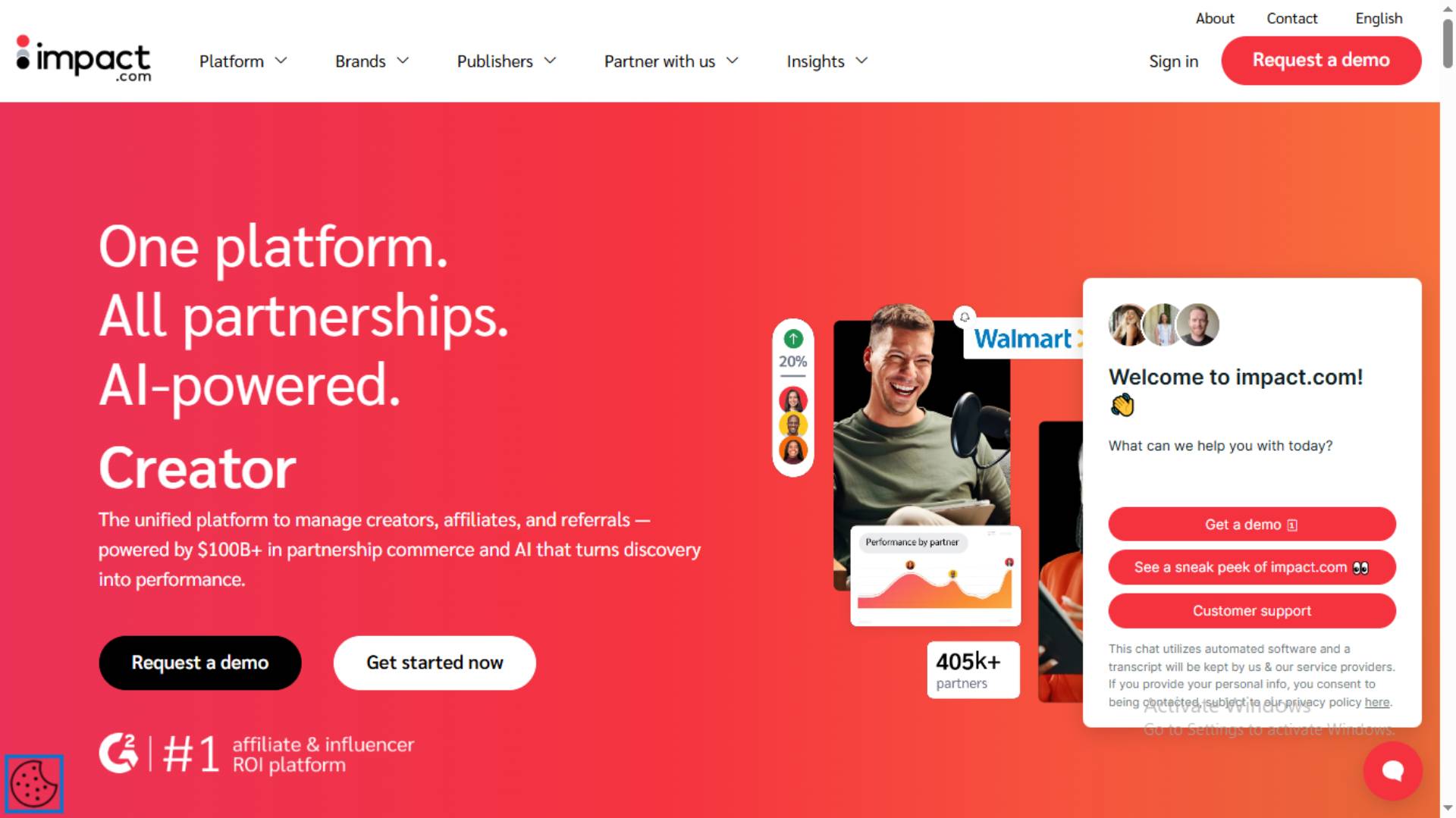
Among modern Creator Marketing Platforms, impact.com is different from many traditional influencer tools because creator marketing sits within a broader partnership-management ecosystem that also covers affiliates and other performance partnerships.
Its Creator capabilities include discovery, campaign management, flexible compensation, product gifting, performance tracking and creator payments. Brands can use flat fees, performance-based compensation and gifting within campaigns. Shopify can also be connected for product gifting.
The real advantage appears when a company wants influencer marketing and affiliate marketing to operate together. impact.com now includes core Creator and Advocate capabilities directly within its Performance Platform, allowing brands to manage different partnership types from the same environment.
Published Performance pricing currently starts at $30 per month for Starter, $500 per month for Essentials and $2,500 per month for Pro, with Enterprise pricing available on request. However, capabilities differ substantially between editions. Marketplace access, for example, starts with Essentials, while advanced Creator features can involve Premium configurations.
impact.com is perfect for:
- Brands running affiliate and creator partnerships together.
- Performance-focused ecommerce teams.
- Businesses that need flexible commission structures.
- Companies that want partner tracking beyond traditional influencer campaigns.
impact.com is not suited for:
- Teams wanting a platform devoted exclusively to influencer discovery.
- Buyers that prefer a very simple creator-only product.
- Organisations unwilling to evaluate edition, usage and payout-related costs carefully.
9. Captiv8
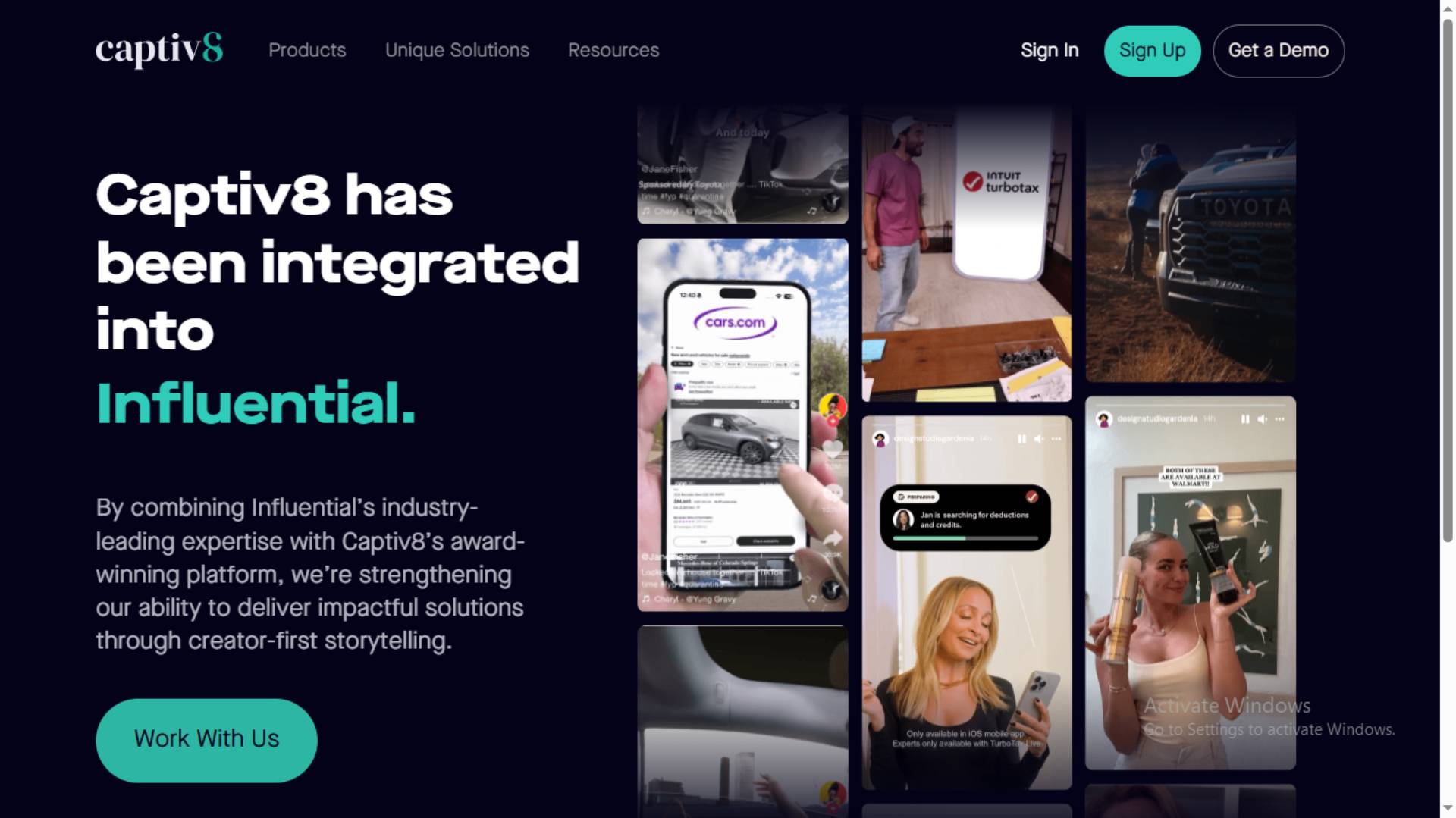
Captiv8 combines influencer discovery, campaign management, creator payments, affiliate functionality and measurement, but its brand-safety capabilities make it particularly relevant to larger organisations managing reputational risk.
Campaign teams can build briefs, manage partnership terms, communicate with creators, approve content, coordinate gifting and product fulfilment, generate referral links and manage payments within the platform. Shopify connectivity supports product delivery and ecommerce-oriented creator workflows.
Captiv8 also provides global creator payments, supporting more than 150 currencies according to its current payments page.
Its Brand & Media Safety functionality goes beyond checking creators’ own social posts. Captiv8 says the system can also monitor third-party media references and apply risk scoring using IAB-standard categories, giving enterprise brands another layer of creator vetting.
Pricing is not publicly listed, with prospective customers directed toward a platform tour or demo.
Captiv8 is perfect for:
- Enterprise brands where creator and media safety are important.
- Companies managing larger creator payment operations.
- Teams combining organic influencer activity, paid amplification and affiliate campaigns.
- Organisations requiring detailed full-funnel measurement.
Captiv8 is not suited for:
- Small teams wanting straightforward self-service pricing.
- Businesses that need only a lightweight influencer database.
- Buyers that do not require enterprise workflow, measurement or risk-management capabilities.
10. Flowbox
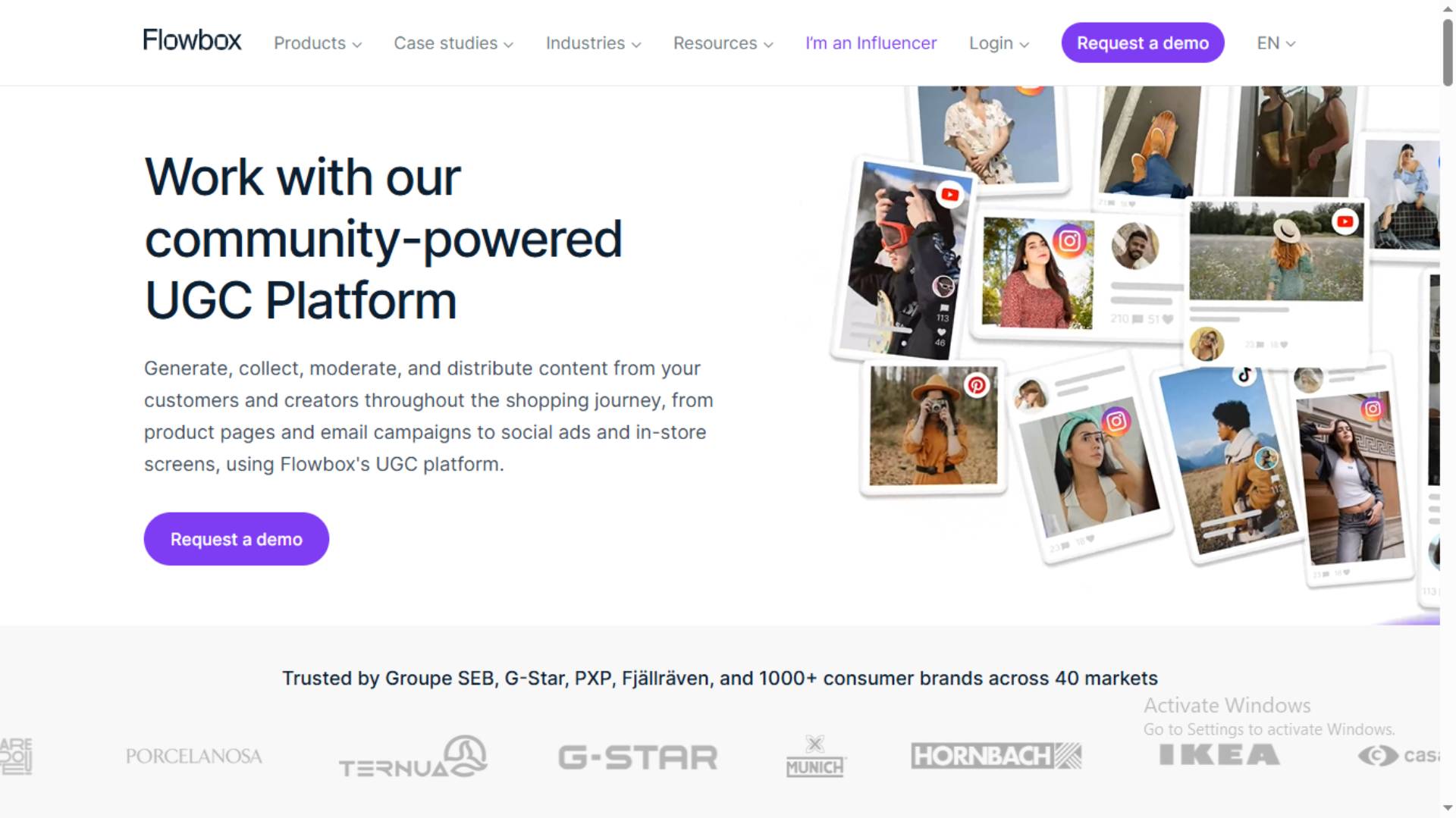
Flowbox brings influencer marketing into a broader UGC, social commerce and social media marketing environment. That makes it meaningfully different from platforms that focus primarily on creator search or campaign administration.
Its influencer marketing product supports creator discovery, relationship management, campaigns, automatic content tracking and creator payments. Flowbox currently promotes access to more than 18,000 vetted influencers alongside global search across roughly 300 million creators.
The bigger differentiator is what brands can do with creator and customer content afterwards. Flowbox’s UGC technology can collect and moderate content from platforms including Instagram, TikTok and YouTube, connect that content to products, and distribute it across ecommerce sites, email, ads and other touchpoints.
For European organisations, Flowbox also emphasises GDPR-oriented rights workflows, EU data residency, DAC7 reporting and multi-market consent capabilities. Its platform advertises more than 50 ecommerce and marketing integrations.
Pricing is not publicly listed; businesses are directed to request a demo.
Flowbox is perfect for:
- Ecommerce brands combining influencer marketing with UGC and social commerce.
- European and multi-market teams concerned with creator-content rights and compliance workflows.
- Companies that want to reuse creator content throughout the shopping journey.
- Brands looking to connect influencer programs with onsite social proof and shoppable content.
Flowbox is not suited for:
- Businesses needing only a basic influencer-search database.
- Small one-off campaigns that do not need UGC or social-commerce infrastructure.
- Buyers who require transparent self-service pricing.
Influencer Marketing Platforms Comparison
| Platform | Discovery | Campaigns | UGC | Ecommerce | Analytics | Payments | Pricing |
|---|---|---|---|---|---|---|---|
| CreatorIQ | Advanced | Advanced | Strong | Integrations | Enterprise | Yes | Quote only |
| GRIN | Yes | Advanced | Yes | Strong | Strong | Yes | Excellent |
| Aspire | Advanced | Advanced | Strong | Strong | Strong | Yes | Quote only |
| Upfluence | Advanced | Advanced | Yes | Strong | Strong | Yes | Custom |
| Modash | Advanced | Strong | Tracking | Shopify | Strong | Yes | High |
| HypeAuditor | Advanced | Strong | Tracking | Integrations | Very strong | Yes | Limited |
| Traackr | Advanced | Advanced | Content | Available | Very strong | Varies | Quote only |
| impact.com | Marketplace | Strong | Content | Strong | Performance | Yes | High |
| Captiv8 | Advanced | Advanced | Strong | Strong | Advanced | Yes | Quote only |
| Flowbox | Advanced | Strong | Core | Very strong | Strong | Yes | Quote only |
This Influencer Platforms Comparison should be used as a shortlist rather than an absolute scorecard. For example, HypeAuditor’s depth in audience analysis does not automatically make it a better ecommerce platform than Aspire, while Flowbox’s strength in shoppable UGC may be unnecessary for a company that only needs creator discovery.
Which Influencer Marketing Platform Is Best for Your Needs?
| Use Case | Recommended Platform | Why |
|---|---|---|
| Enterprise creator marketing | CreatorIQ | Governance, workflows, global program management and measurement |
| AI-assisted creator operations | GRIN | Gia can perform discovery, outreach, gifting and reporting tasks |
| Ecommerce creator communities | Aspire | Marketplace, Shopify, gifting, affiliates and relationship workflows |
| Ecommerce sales attribution | Upfluence | Strong commerce integrations and creator revenue tracking |
| Lean teams and discovery | Modash | Large creator database, straightforward workflow and transparent pricing |
| Influencer analytics | HypeAuditor | Deep audience, authenticity and competitive intelligence |
| Global program measurement | Traackr | Structured data, planning and ongoing program analytics |
| Creator + affiliate programs | impact.com | Unified partnership and performance infrastructure |
| Brand safety | Captiv8 | Social-content and wider media-risk analysis |
| UGC and social commerce | Flowbox | Influencer campaigns connect directly with shoppable UGC workflows |
How to Choose the Right Influencer Marketing Platform
Define Your Campaign Goals
Start with the outcome rather than the software.
A brand focused on awareness might prioritise creator discovery, audience fit and content performance. An ecommerce business may care more about promo codes, product gifting, affiliate tracking and revenue attribution.
Enterprise teams may require something different again: permissions, global reporting, multiple teams, compliance, payment administration and governance.
Before comparing demonstrations, identify which parts of the influencer workflow are essential.
Check Creator Discovery Capabilities
A huge influencer database sounds impressive, but database size should not be your only criterion.
Consider whether you can filter creators by:
- audience location;
- audience age and gender;
- creator location;
- interests;
- engagement;
- follower size;
- previous brand collaborations;
- audience authenticity;
- keywords or content;
- lookalike creators.
Also determine whether discovery relies on an open social-data database, an opt-in marketplace, or a combination of both.
Each model creates a different recruitment experience.
Consider Your Main Social Networks
Confirm that the software supports the platforms your audience actually uses.
Instagram, TikTok and YouTube are widely covered, but support for Twitch, Pinterest, X and emerging channels varies between providers.
Do not assume that a platform supporting creator discovery on a social network also offers identical campaign tracking, audience analytics and content metrics for that network.
Evaluate Ecommerce Integrations
For ecommerce businesses, this can be one of the biggest differences between platforms.
Check whether the software can:
- connect to your store;
- ship products to creators;
- create discount codes;
- generate affiliate links;
- attribute sales;
- calculate commissions;
- track returns;
- manage creator payouts.
Shopify is widely supported, but brands using WooCommerce, Magento, BigCommerce, Amazon or custom storefronts should investigate integration depth carefully. Brands may also want creator data to connect with their email marketing software, CRM and other customer-marketing systems.
Compare Analytics and Attribution
Reporting should match your campaign objective.
Awareness programs may focus on reach, views, engagement and content performance. Ecommerce campaigns may require clicks, conversions, revenue, average order value and return on ad spend.
Be particularly cautious with estimated metrics such as earned media value. Different platforms can use different methodologies, so an EMV figure should not automatically be treated as equivalent to actual revenue.
Look at Campaign Management Features
Discovery is only the beginning. Effective Influencer Campaign Management Tools should support the operational work that begins after a creator has been discovered and selected.
If your team works with dozens or hundreds of creators, evaluate whether the system can manage:
- outreach;
- creator status;
- contracts;
- campaign briefs;
- content approvals;
- publishing deadlines;
- gifting;
- payments;
- creator communication;
- campaign reporting.
A powerful discovery engine paired with weak operational tools can simply move your spreadsheet problem somewhere else.
Understand Pricing and Contracts
Looking beyond headline software pricing is important because usage limits, add-ons and overage charges can materially affect the real cost of a platform.
You may encounter:
- monthly subscriptions;
- annual contracts;
- custom enterprise quotes;
- usage or credit limits;
- creator limits;
- payment-processing fees;
- campaign limits;
- email-unlock limits;
- additional service packages.
Request a complete cost breakdown before comparing platforms on price.
For example, GRIN now uses credits for AI-assisted work, Modash scales usage limits by plan, and Upfluence uses custom modules and normally requires a 12-month commitment.
Consider Scalability
The cheapest platform for a five-creator pilot may not be the cheapest platform for an always-on program involving 500 creators.
Consider how the software handles increased:
- creator volume;
- team members;
- campaigns;
- markets;
- stores;
- payment volume;
- reporting requirements.
Growing teams may also benefit from business automation tools that connect campaign data with other sales, marketing and operational systems.
Common Mistakes When Choosing Influencer Marketing Software
When comparing Top Influencer Marketing Software, one common mistake is selecting a platform because it advertises the largest creator database. Database size means little if the software cannot identify relevant creators or provide enough audience information to evaluate them.
Another mistake is paying for enterprise infrastructure too early. A small brand managing ten creators may not need complex permissions, global reporting and multi-market governance. Conversely, a global business should not select lightweight software merely because it has a convenient monthly subscription.
Integrations are another frequent oversight. A platform may appear impressive during a demo but create more manual work if it does not integrate properly with the company’s ecommerce, affiliate, CRM or analytics systems.
Brands should also investigate attribution before buying. “Influencer analytics” can mean anything from engagement reporting to real conversion tracking. Ask exactly how sales, links, codes and customer journeys are measured.
Contract terms require similar attention. Check minimum commitments, onboarding costs, usage limits, payment charges and cancellation terms before signing.
Finally, do not overlook compliance and creator disclosures. In the United States, the FTC states that material connections between brands and endorsers should be clearly disclosed, including relationships involving payment or free products. Similar requirements exist in other jurisdictions, so campaign processes should make disclosure expectations clear.
Final Thoughts
The best influencer marketing platforms in 2026 solve very different problems.
CreatorIQ and Traackr are well aligned with mature global programs where governance, measurement and scale matter. GRIN offers a more accessible self-service route with AI-assisted operations and published pricing. Aspire and Upfluence are particularly relevant to ecommerce companies building creator, affiliate and product-seeding programs.
Modash offers an attractive balance of broad discovery, campaign tools and pricing transparency for leaner teams, while HypeAuditor remains particularly strong where creator vetting, audience quality and competitive intelligence are priorities.
impact.com makes sense when creators are part of a wider performance-partnership strategy. Captiv8 brings additional brand-safety capabilities for enterprise teams, while Flowbox stands apart by connecting influencer marketing with UGC and social commerce.
There is therefore no universal winner.
Use this Influencer Marketing Platform Guide to identify the part of your creator program that creates the most friction—discovery, management, content, ecommerce attribution, analytics, payments, or scale—and shortlist platforms whose strongest capabilities match that requirement.
